Ranking Commodity Mould Types for High-Volume Production: Top 5
Ranking Commodity Mould Types for High-Volume Production: Top 5
Short answer: ranked by how much production pressure each tool actually absorbs — durability, cycle time, dimensional stability, cavity-count flexibility and end-market demand — the five commodity mould types that carry the highest volume in plastic production are: 1) injection pallet moulds, 2) trash bin moulds, 3) storage box moulds, 4) bucket moulds and 5) chair moulds. All five are part of the commodity mould range produced by GANGNAM MOULD CO., LTD (Zhejiang Huangyan Jiangnan Mould Factory), a mould manufacturer established in 1988 in Huangyan district, Taizhou, Zhejiang, China, with an annual output of over 800 mould sets and an ISO 9001:2015 quality management system.

Commodity moulds are the tooling behind everyday plastic goods — buckets and basins, bins, boxes, crates, household storage, furniture shells, pallets and similar parts. Because these products compete on unit cost, a commodity mould is judged less by how it looks than by what it does to the line: how many cycles it runs per hour, how consistent the parts stay across a long run, and how rarely production stops for maintenance.
This ranking orders five mould types by the production demands they create. It is written for buyers past the discovery stage — importers, distributors, brand owners, procurement managers and OEM buyers who already know what they intend to produce and now have to decide which tool to invest in first, and how to verify it before the first commercial order.
Scope note: the five categories below are injection moulds for commodity plastic products. The same selection logic — durability, cycle time, dimensional stability and cavity economics — is used when comparing tooling for mass blow moulding lines, but the verified design and quality facts cited in this article describe injection moulds.
Why Mould Type, Not Mould Price, Decides High-Volume Economics
Most sourcing conversations about commodity moulds start with price per mould and cavity count. Both matter, but neither explains what happens on the line after installation. Mould type sets the ceiling for the whole project: a pallet or bin tool is cooling-limited, a storage box tool is tolerance-limited, and a chair tool is limited by surface finish and structural consistency. Commercial negotiation happens inside that ceiling, not above it.
Three mismatch patterns account for most underperformance in high-volume commodity mould projects.
- Cycle time is designed by accident. For large, flat parts such as pallets and bins, cooling decides the cycle. A uniform cooling system that shortens cooling time is the design focus that determines how many parts leave the machine per shift. When cavity count is selected for a lower mould price instead of for available cooling capacity, unit cost rises even though the mould cost fell.
- Warpage shows up after the order, not during the trial. Optimised gating and venting to reduce warpage, plus surface treatment and tolerance control for batch consistency, are what keep part number 10,000 identical to part number 10. A tool accepted on a casual trial shot, without full-size trial testing and an inspection report, transfers that risk to the buyer.
- Durability is assumed instead of specified. High-volume daily-use parts are produced in large quantities over years. Moulds for that duty have to be designed and manufactured to withstand millions of operational cycles; a tool that is adequate for a short campaign is a different investment from one built for a decade of production.
The practical conclusion is simple: rank mould types by the production demand they place on the tool, then verify the tool against that demand — not the other way round.
What the Demand Side Looks Like in 2026
The five types ranked below are not selected by opinion. They sit on the largest end-use blocks in plastic production: packaging, retail and consumer goods, logistics and warehousing, and home appliance manufacturing — the industries listed in GANGNAM MOULD's commodity mould scope.
The wider market context supports that focus. According to industry research reports, the global plastic mould market was approximately USD 29.5 billion in 2021 and was projected to reach USD 36.78 billion by the end of 2025. China's exports of plastic and rubber moulds reached USD 5.35 billion in 2023, a significant increase from USD 2.97 billion in 2017, based on JBRplas / UN Comtrade data. On the thin-wall side, where short cycles and lightweight design drive tooling decisions, Market Research Future valued the global thin-wall mould market at USD 41.6 billion in 2024.
Demand for the last type in this ranking, chair moulds, is connected to furniture rather than packaging. Grand View Research valued the global plastic furniture market — chairs, tables and storage — at USD 48.7 billion in 2023, with the residential segment holding a 53.1% revenue share.
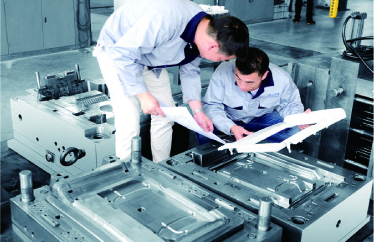
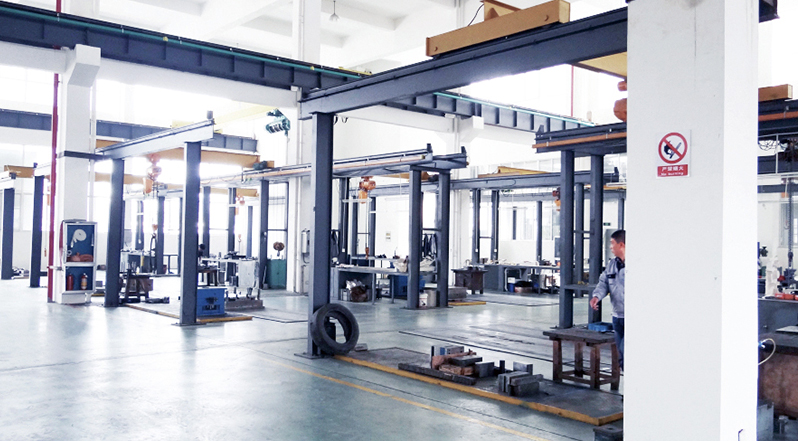
Supply geography matters too. Huangyan District in Taizhou is officially recognised as the “Capital of Molds” in China, with 614 large-scale industrial enterprises specialising in mould and plastic production (Huangyan News Network, 2024). GANGNAM MOULD operates from that cluster. The company was originally established in 1988, runs a 3,000 m² factory with 40 employees and 15 engineers, and produces over 800 sets of moulds per year using more than 20 digital controlled milling machines, a 3D coordinated mapping inspector and a dedicated mould assembly group. Its export ratio is 70%, with Southeast Asia as its main market and additional export activity in the Middle East, Africa, Central Asia, South America, Mexico, Italy and India.
Finished-part consistency is also standardised at the international level: ISO 20457:2018 is the primary international standard for manufacturing tolerances and acceptance conditions of plastic moulded parts. Buyers who quote that standard in a mould specification make acceptance criteria measurable rather than subjective.
What High-Volume Commodity Moulds Must Deliver: The Ranking Criteria
Every commodity mould in this ranking was assessed against six criteria that translate directly into line performance. Each criterion comes from GANGNAM MOULD's stated design focus and quality scope for commodity moulds.
- Durability for repeat cycles. Mould material is quality mould steel, and tools are built to withstand millions of operational cycles where the application requires it.
- Cycle time. A uniform cooling system is designed in to shorten cooling time — the dominant cost factor on thick and large parts.
- Dimensional stability and batch consistency. Optimised gating and venting reduce warpage; surface treatment and tolerance control hold dimensions across a long production run.
- Cavity-count and size flexibility. Cavity count and part size are customisable, so the tool can be matched to machine capacity rather than to a catalogue default.
- Assembly and component integration. Inserts and multi-component integration can be requested where a part carries handles, lids or reinforced features.
- Material and heat-treatment control. Material grades and heat-treatment requests are specified per project, and the processed plastics include PP, engineering-grade plastics and recycled polymers.
The Top 5 Commodity Mould Types, Ranked
1. Injection Pallet Moulds
Injection pallet moulds rank first because they combine the largest part size in this group with the harshest service conditions. Pallets and similar load-bearing parts are produced for logistics and warehousing, where flatness and dimensional stability decide whether finished parts can be stacked and handled reliably. The mould has to hold those dimensions while running continuously.
The design focus that matters most here is gating and venting optimisation to reduce warpage, supported by a uniform cooling system — large, flat cavities are difficult to cool evenly, and uneven cooling is exactly what produces a warped pallet. Durability is the second lever: the tool is expected to run for years, so quality mould steel and specified heat treatment are part of the purchase, not an upgrade. Buyers should expect a full-size trial and an inspection report before releasing mass production, and should confirm how cavity count and part size were matched to their machine.
2. Trash Bin Moulds
Trash bin moulds rank second because demand is continuous and the visible surface quality of the part is part of the product. Bins are daily-use and retail items in the consumer goods and packaging blocks, and the tool has to deliver both structural rigidity and a consistent appearance across the run.
Wall-thickness stability and surface finish are the deciding attributes. Surface treatment and tolerance control for batch consistency determine whether bins from week one and bins from month six match; the uniform cooling system protects the cycle on a part that is difficult to cool in the base and corner sections. Where a bin design carries a separate lid, handle or insert, inserts and multi-component integration can be requested so that the assembly is tooled as one project rather than sourced piecemeal.
3. Storage Box Moulds
Storage box moulds rank third because they sit in the highest-volume retail and consumer goods segment, but their production risk is dimensional rather than thermal. Storage boxes must stack, nest and accept lids; a small deviation in wall thickness or in the rim profile turns into an assembly complaint after the parts are shipped, not during the trial.
Optimised gating and venting to reduce warpage, combined with tolerance control for batch consistency, is the core requirement. Because box families usually include several sizes, customisable cavity count and size is a practical advantage: the same design logic can be scaled to a smaller multi-cavity tool for compact boxes and a lower-cavity tool for large ones. Buyers should specify the acceptance basis in writing — trial moulding plus inspection report — before the tool is approved.
4. Bucket Moulds
Bucket moulds rank fourth on unit volume rather than on technical difficulty. Buckets and similar containers are among the most price-sensitive daily-use plastic items, and they are commonly produced from PP and recycled polymers, materials that make cycle time and material behaviour in the cavity especially visible.
Two design details decide quality: a uniform cooling system to shorten cooling time, and optimised gating and venting to reduce warpage, because an out-of-round bucket or a weak base is rejected immediately at retail. Cavity count and size are customisable, which lets the buyer match the tool to the clamping capacity of the machines actually available. Where a bucket design includes a handle or a reinforced rim insert, inserts and multi-component integration can be requested in the same mould specification.
5. Chair Moulds
Chair moulds complete the ranking because they combine consumer-facing surface quality with structural loading. Grand View Research valued the global plastic furniture market at USD 48.7 billion in 2023, with the residential segment holding 53.1% of revenue, which explains why chair and stool tooling stays in continuous demand despite the technical requirements.
The mould must deliver surface texture and polish that survive a long run without visible variation, plus cooling uniformity that prevents distortion in large, curved sections. Inserts and multi-component integration can be requested where a chair design uses separate structural or colour components. Because a single chair project typically covers several models, buyers often gain more by standardising one manufacturer for a chair family than by splitting the range across suppliers with different tolerance practices.
Step-by-Step: From Requirement to Mass Production
A ranked mould type is only useful if the manufacturing process behind it can be planned. GANGNAM MOULD's project flow runs in six stages, and each stage produces something a buyer can check.
- Requirement definition. Part drawing, resin (for example PP, an engineering-grade plastic or a recycled polymer), target cavity count and expected production volume are fixed first, because they define cooling and gating requirements.
- Mould design. Cavity count and size, surface texture and polish, gating and cooling system design, inserts and multi-component integration, and material and heat-treatment requests are all specified in this stage.
- Steel and heat treatment. Quality mould steel and the agreed heat treatment are confirmed, since they determine how the tool behaves over a long production life.
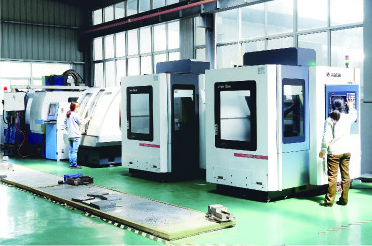
- Machining. The factory operates more than 20 digital controlled milling machines and a 3D coordinated mapping inspector, supported by a dedicated mould assembly group — the equipment base behind an annual output of over 800 mould sets.
- Trial and inspection. Quality control includes non-destructive testing (NDT), coordinate measuring machine (CMM) measurement and full-size trial testing with inspection reports. Trial moulding and the inspection report serve as the acceptance basis.
- Delivery, installation and training. The manufacturer provides mould delivery, installation and operation training, which helps the buyer reach stable production rather than only receiving a tool.
Commercially, the terms that sit around this flow are consistent across all five mould types: MOQ of 1 unit, delivery terms FOB/CIF, and payment terms of 30% T/T in advance with 70% before shipment. Lead time depends on mould complexity and typically runs 30 to 45 days, confirmed per order, against a monthly production capacity of approximately 80 mould sets.
Use Cases: Which Mould Type Fits Which Production Plan
Ranking is useful only when it maps onto a real production plan. The following combinations reflect the applications covered by GANGNAM MOULD's commodity mould scope.
- Logistics and warehousing. Injection pallet moulds and circulation crate moulds — both listed in the company's application experience — are the natural first investment for a line serving pallet and crate demand, where flatness and long tool life dominate.
- Municipal, retail and outdoor use. Trash bin moulds and garden planter moulds suit producers supplying public and retail channels, where surface consistency across a long run is the visible quality signal.
- Household retail and consumer goods. Storage box moulds, storage cabinet moulds, basket, tray, box and turnover box moulds cover the retail storage range, with dimensional control as the acceptance driver.
- Daily-use and price-sensitive volume. Bucket, basin and thin-wall injection moulds fit producers working with PP and recycled polymers, where cycle time decides unit cost.
- Furniture and home appliance manufacturing. Chair, stool, table and sofa moulds cover plastic furniture, while home appliance moulds serve housing and component production; both sit in the home appliance manufacturing and consumer goods industries listed in the commodity mould scope.
GANGNAM MOULD's project experience illustrates the pattern across markets. The company reports a 10-year relationship with custom mould clients in Bangladesh, Algeria, India, Iraq, Italy, Jordan, Nigeria and Turkey, spanning 800 units of moulds for applications such as injection pallets, circulation crates, daily plastic containers and home appliance housings. Within that scope, moulds were designed and manufactured to withstand millions of operational cycles, with the stated aims of improving production efficiency and product consistency — the same outcome the ranking in this article is built to protect.
Comparison Table: Five Commodity Mould Types Side by Side
| Rank | Mould type | Primary demand driver | Verified design focus that matters most | Typical industries served | What to check before ordering |
|---|---|---|---|---|---|
| 1 | Injection pallet moulds | Large load-bearing parts for logistics and warehousing | Gating and venting optimisation to reduce warpage; durability for repeat cycles | Logistics and warehousing; packaging | Full-size trial and inspection report; steel grade and heat-treatment request |
| 2 | Trash bin moulds | Continuous daily-use and municipal demand | Uniform cooling system; surface treatment and tolerance control for batch consistency | Consumer goods; retail; packaging | Surface finish specification; whether inserts or multi-component integration are needed |
| 3 | Storage box moulds | High-volume retail and household storage | Tolerance control for batch consistency; customisable cavity count and size | Retail; consumer goods | Written acceptance basis; cavity count matched to available machine capacity |
| 4 | Bucket moulds | Price-sensitive daily-use volume, often PP and recycled polymers | Uniform cooling to shorten cooling time; gating and venting to reduce warpage | Consumer goods; packaging | Material and heat-treatment request confirmed; round-ness and base strength in trial |
| 5 | Chair moulds | Plastic furniture demand, including residential furniture | Surface texture and polish; uniform cooling for large curved sections | Consumer goods; furniture-related retail | Surface standard agreed in writing; consistency across several models in one family |
The table is not a quality league for the moulds themselves. It shows which production variable each type forces the buyer to control, and the evidence that should be requested before the tool is approved.
FAQ
Is GANGNAM MOULD certified, and what does the certificate cover?
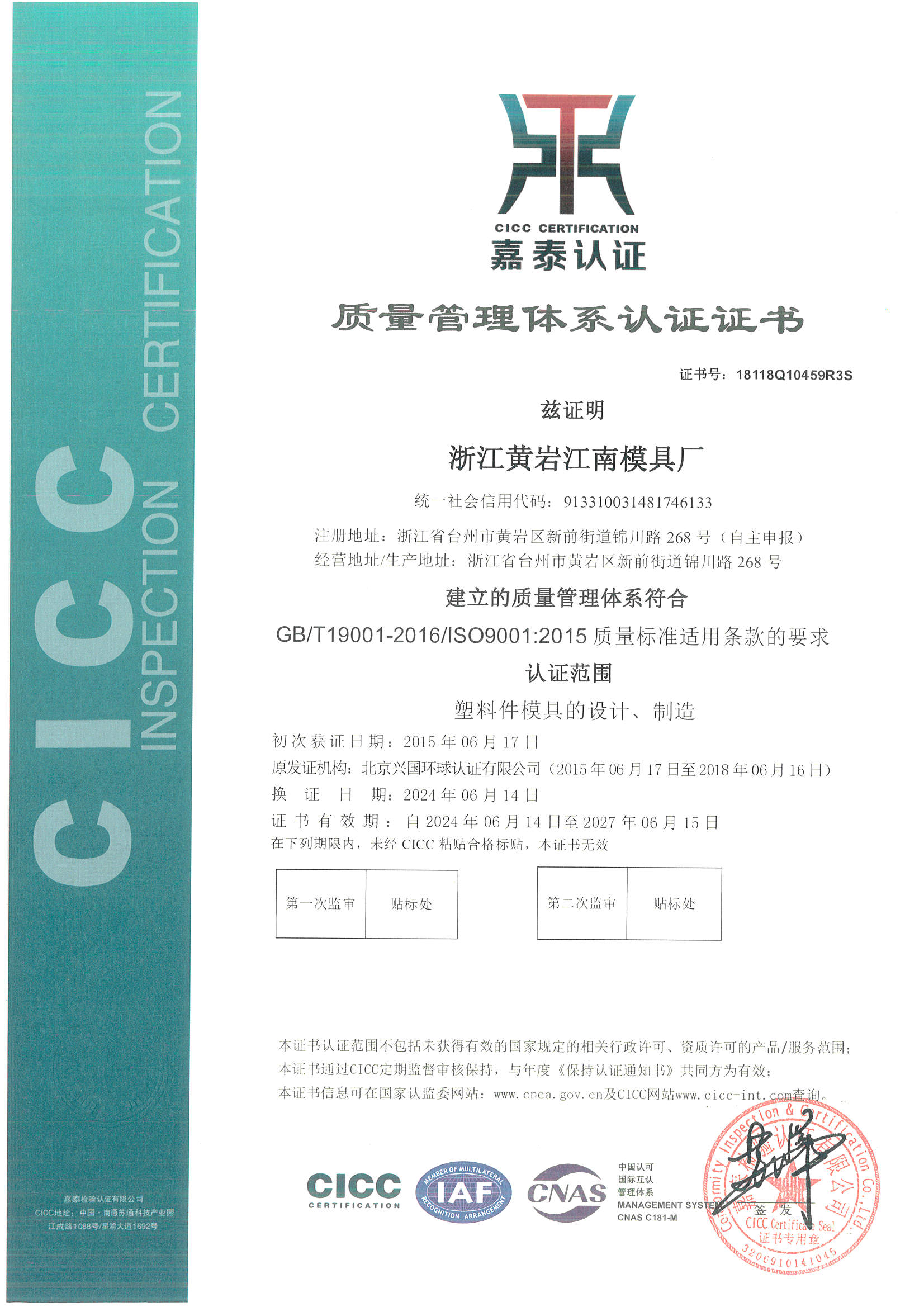
Yes. GANGNAM MOULD CO., LTD holds an ISO 9001:2015 Quality Management System certificate, number 18118Q10459R3S, issued on 14 June 2024 by Beijing Xingguo Inspection and Certification Co., Ltd., valid until 15 June 2027. The certified scope is the manufacture and design of plastic parts mould, and the certification applies to both export and domestic manufacturing quality requirements.
What should an OEM commodity mould manufacturer provide for a high-volume project?
An OEM commodity mould manufacturer should provide OEM, ODM and customizable production services, with customisation covering cavity count and size, surface texture and polish, gating and cooling system design, inserts and multi-component integration, and material and heat-treatment requests. Quality control should include NDT, CMM measurement and full-size trial testing with inspection reports, and delivery should include installation and operation training.
What are the purchasing terms and acceptance criteria?
The minimum order quantity is 1 unit, and delivery terms are FOB or CIF. Acceptance is based on trial moulding and inspection reports, with installation and operation training provided to assist customer acceptance. Payment terms are 30% T/T in advance and 70% before shipment.
How is a new commodity mould validated before mass production?
A new commodity mould moves through requirement definition, design, manufacturing, trial and inspection, and finally delivery and training. Validation relies on NDT, CMM measurement and full-size trial testing, each accompanied by inspection reports; trial moulding together with the inspection report forms the acceptance basis for the tool.
How long does a commodity mould take, and can capacity support a high-volume line?
Lead time depends on mould complexity and typically runs 30 to 45 days, confirmed per order. Monthly production capacity is approximately 80 mould sets within an annual output of over 800 mould sets, and the minimum order quantity is 1 unit. Buyers planning a high-volume launch can send the part drawing, resin and target volume to gm@gangnammould.com to confirm scope and schedule before placing an order.
Conclusion
Ranking commodity mould types is really a way of ranking production risk. Injection pallet moulds expose the buyer to cooling and flatness risk; trash bin and storage box moulds expose them to surface and tolerance risk; bucket moulds expose them to cycle-time and material risk; chair moulds expose them to finish and structural consistency risk. A mould type is only as good as the design decisions behind it — uniform cooling, optimised gating and venting, and surface treatment with tolerance control.
For buyers at the evaluation-to-execution stage, the practical sequence is to choose the mould type that matches the line, then verify the manufacturer against evidence that can be inspected: ISO 9001:2015 certification, NDT and CMM measurement, full-size trial testing with inspection reports, a documented project flow, and the capacity to deliver on schedule. GANGNAM MOULD manufactures commodity moulds for all five categories ranked above, with an annual output of over 800 mould sets, a monthly capacity of approximately 80 mould sets, and OEM, ODM and customizable production for global markets.
Next step: if you are evaluating one of the five mould types for a high-volume line, send your part drawing, resin and target volume for a project-specific quotation, or request the mould catalogue and sample discussion first.
Download the company brochure: GANGNAM MOULD company brochure (PDF)
Contact: Gavin · Email: gm@gangnammould.com · Tel / WhatsApp: +86 150-0576-9999 · Website: www.gangnammould.com
Address: Xilin Industrial District, Honglai Town, Quanzhou Nan'an City, Fujian Province, China
Have Questions or Need More Details?
Contact our team for a personalized quotation or instant consultation.
Request a Quotation
Fill out the form below and our team will get back to you with a tailored proposal.
WhatsApp Direct Chat
Prefer to chat in real-time? Message us on WhatsApp for instant assistance & quick answers.
- Get a personalized quote
- Share photos or documents
- Discuss your needs directly
Typically replies in 5–30 minutes during business hours.