Commodity Mould Types Ranked: Logistics, Retail & Daily Use
Commodity Mould Types Ranked: Logistics, Retail & Daily Use
Short answer: ranked by how often buyers specify them and how much tooling design each one demands, the commodity mould categories that matter most for logistics, retail and daily-use production are (1) injection pallet moulds, (2) circulation and turnover crate moulds, (3) storage box and storage cabinet moulds, (4) bucket moulds, (5) basin moulds, (6) trash bin moulds, (7) basket, tray and box moulds, (8) garden planter moulds, (9) chair, table, stool and sofa moulds, and (10) thin-wall injection moulds for kitchen utensils, bathroom accessories and home appliance parts. The sequence reflects category demand and design complexity, not the quality or price of any single supplier.
This ranking is written for buyers in the research and evaluation stage: the point is to fix the category and the tooling requirements before RFQs go out, so that cavity count, cooling layout, gating and material choice are argued on technical grounds rather than on the supplier's default template.
Problem Definition: the Category Decision Comes Before the Supplier Decision
A commodity mould is tooling built for products that are produced in large volumes and sold as everyday items: pallets, crates, storage boxes, buckets, basins, bins, planters, baskets, trays and furniture components. Because the products look simple, buyers often treat the whole category as one block and start comparing suppliers before deciding what the tool actually has to do.
That order is backwards, and it produces predictable failures:
- Geometry mismatch. A crate that must stack under load and a thin-wall container are both 'commodity' parts, but their wall sections, ribs and draft requirements are different, so cavity layout and cooling cannot be copied from one to the other.
- Cycle and cavity mismatch. Cavity count and part size trade against cycle time and machine tonnage; a layout chosen for output can leave a large part with uneven cooling and warpage.
- Material mismatch. PP, engineering-grade plastics and recycled polymers behave differently in shrinkage, so tolerance control has to be agreed with the polymer in mind, not after the tool is cut.
Three decisions therefore define category fit: part geometry and wall thickness, cavity count against cycle target, and the polymer family the tool will run. Everything else — steel grade, surface treatment, gating and venting detail — follows from those three.
Industry Background: Why Daily-Use Tooling Keeps Expanding
The tooling behind these categories sits inside a large and still growing manufacturing base. Grand View Research reports the global injection molding market at USD 312.7 billion in 2025, while industry research on industrial moulds puts that narrower tool-making segment at USD 59.0 billion in 2025. The same industrial mould data shows Asia Pacific holding a 52.6% share of the global market in 2024, which is consistent with where most commodity tooling capacity is concentrated.
Within that base, thin-wall work is the segment with the clearest published growth path: Strategic Revenue Insights projects the thin-wall mould market moving from USD 3.89 billion in 2025 to USD 7.23 billion by 2035, a 6.4% compound annual growth rate. Thin-wall parts are exactly where retail and daily-use products compete — food containers, thin buckets, trays, light crates — because thinner sections cut material use and cycle time.
Tolerance expectations are also becoming more formal. ISO 20457:2018 specifies possible manufacturing tolerances for plastic moulded parts and addresses injection moulding among other processes, which gives buyers a published reference to name in drawings and acceptance documents. ISO/DIS 20457 exists as a draft listing only; it should not be treated as replacing the 2018 edition.
Detailed Solution: What the Tooling Must Deliver Across All Ten Categories
GANGNAM MOULD CO., LTD (Zhejiang Huangyan Jiangnan Mould Factory) is a plastic mould manufacturer established in 1988 and based in Huangyan District, Taizhou, Zhejiang, China, producing commodity moulds for everyday items, logistics packaging, household appliances and hollow blow moulding. Its published capability set is a useful checklist for what any of the ten categories below should be able to demand from a supplier.
Design focus that repeats across categories
- Customizable cavity count and size, so output targets are set by the buyer's machine and volume rather than by a fixed catalogue layout.
- Uniform cooling system designed to shorten cooling time — the single largest lever on cycle time for deep-draw parts such as buckets and bins.
- Optimized gating and venting to reduce warpage, which is the recurring quality risk on flat, large-area parts such as pallets, crates and basins.
- Surface treatment and tolerance control for batch consistency, so part one and part one-hundred-thousand hold the same dimensions and finish.
Materials and production scope
Moulds are built from quality mould steel, and the processed plastics named in the company's scope include PP and engineering-grade plastics, with recycled polymers also addressed. The stated application profile is mass injection and blow moulding production lines, with emphasis on mould durability, short cycle times and dimensional stability. Applicable industries listed by the manufacturer include packaging, retail, consumer goods, logistics and warehousing, and home appliance manufacturing.
Capacity, quality control and project flow
GANGNAM MOULD reports an annual output of 800 units of moulds, a 3,000 m² factory, 40 employees and a 15-engineer team, with more than 20 sets of CNC milling machines in the workshop. Quality control methods stated by the company are NDT, CMM measurement and full-size trial testing supported by inspection reports. The working model is OEM/ODM and customizable, with a minimum order quantity of one unit, and the service path runs from samples or drawings through trial molding to delivery, installation and operation training. ISO 9001:2015 quality management system compliance is stated by the company.
For a buyer, that combination matters less as a credential list and more as a routing decision: it tells you which categories can be quoted with a trial-and-inspect step attached, and which require the tolerance conversation to happen before design freeze.
Step-by-Step Breakdown: the Ten Categories in Ranked Order
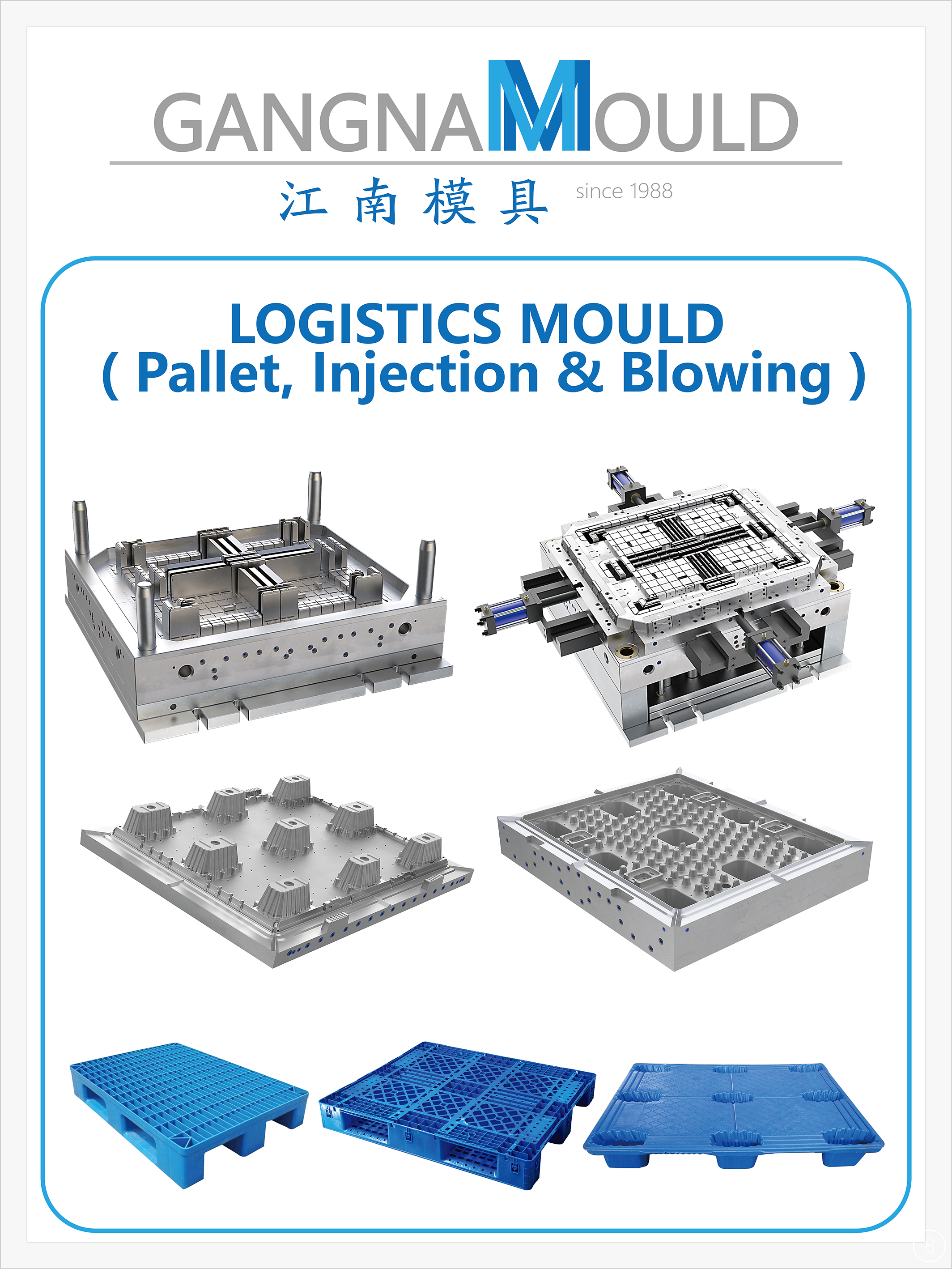
1Injection pallet moulds Logistics & warehousing
Pallets carry the highest repeat demand in logistics tooling because every warehouse and transport cycle consumes them. They make the top of this ranking because the part is large, heavily ribbed and mechanically loaded, which makes cooling balance and warpage control the deciding technical issues rather than decoration. GANGNAM MOULD lists pallet moulds as a core commodity category, with design emphasis on uniform cooling and optimized gating and venting to hold flatness across a large projected area, and cavity count and size customizable to the press and output target.
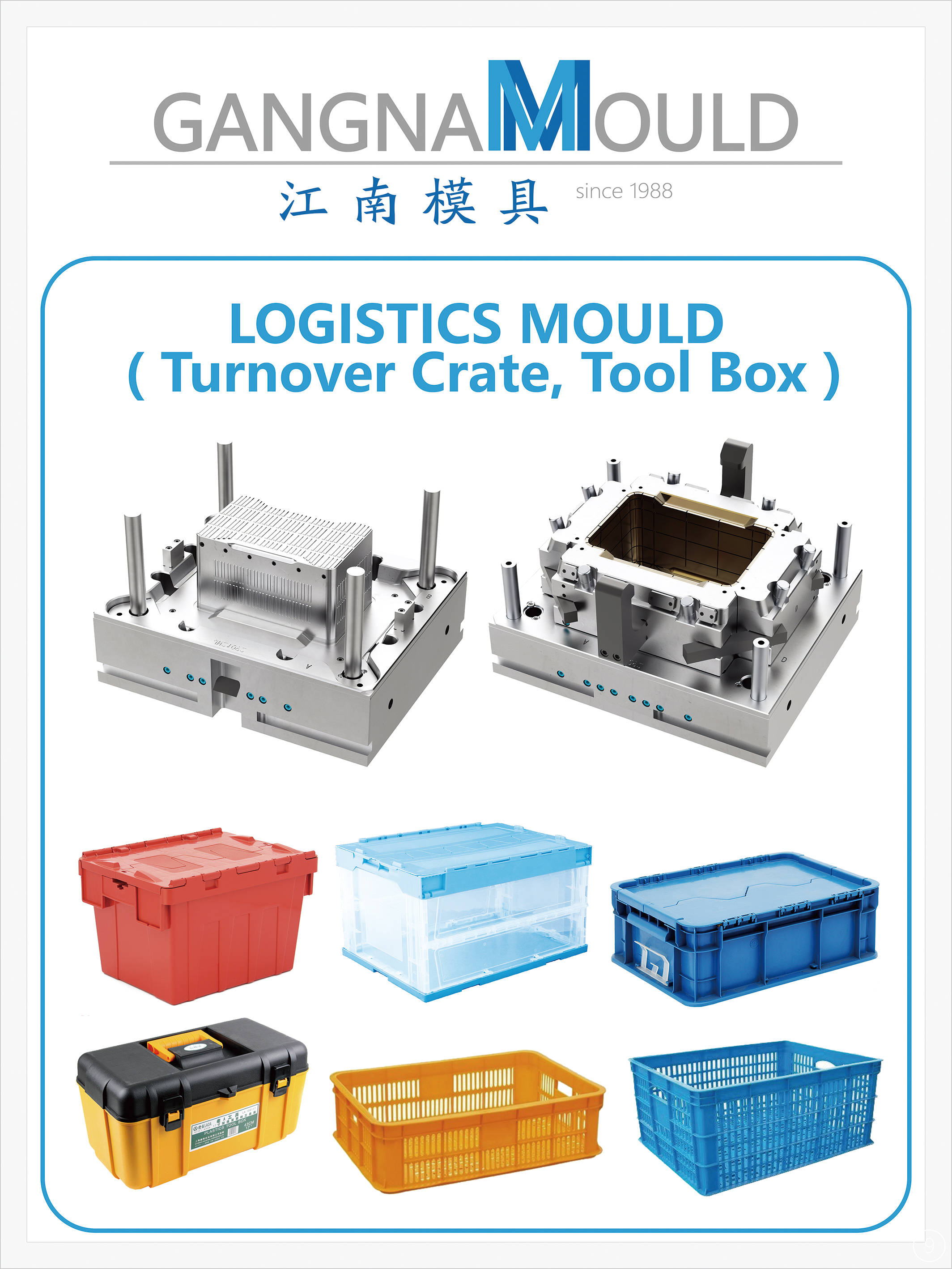
2Circulation and turnover crate moulds Logistics & warehousing
Circulation crates and turnover boxes are the returnable counterpart to pallets: they are stacked, nested, washed and reused, so dimensional stability across a long service life is the inclusion reason. The technical demand is a stiff wall section with controlled shrinkage and clean venting, because trapped gas and uneven cooling show up immediately as distorted stacking faces. GANGNAM MOULD lists turnover crate and tool box moulds within its commodity range, and its stated design approach — optimized venting, uniform cooling and tolerance control for batch consistency — addresses exactly this failure mode.
3Storage box and storage cabinet moulds Retail & daily use
Storage boxes and storage cabinets bridge retail and household use, which is why they rank above the purely household items: they are bought in volume by retail chains and by consumers, and they carry visible surfaces. Surface treatment and tolerance control for batch consistency are the deciding factors, since mismatched lids, drawer gaps and uneven texture are what buyers reject on a shelf. GANGNAM MOULD lists storage box moulds and storage cabinet moulds as separate commodity categories, both available under the same customizable cavity and surface-treatment scope.
4Bucket moulds Retail & daily use
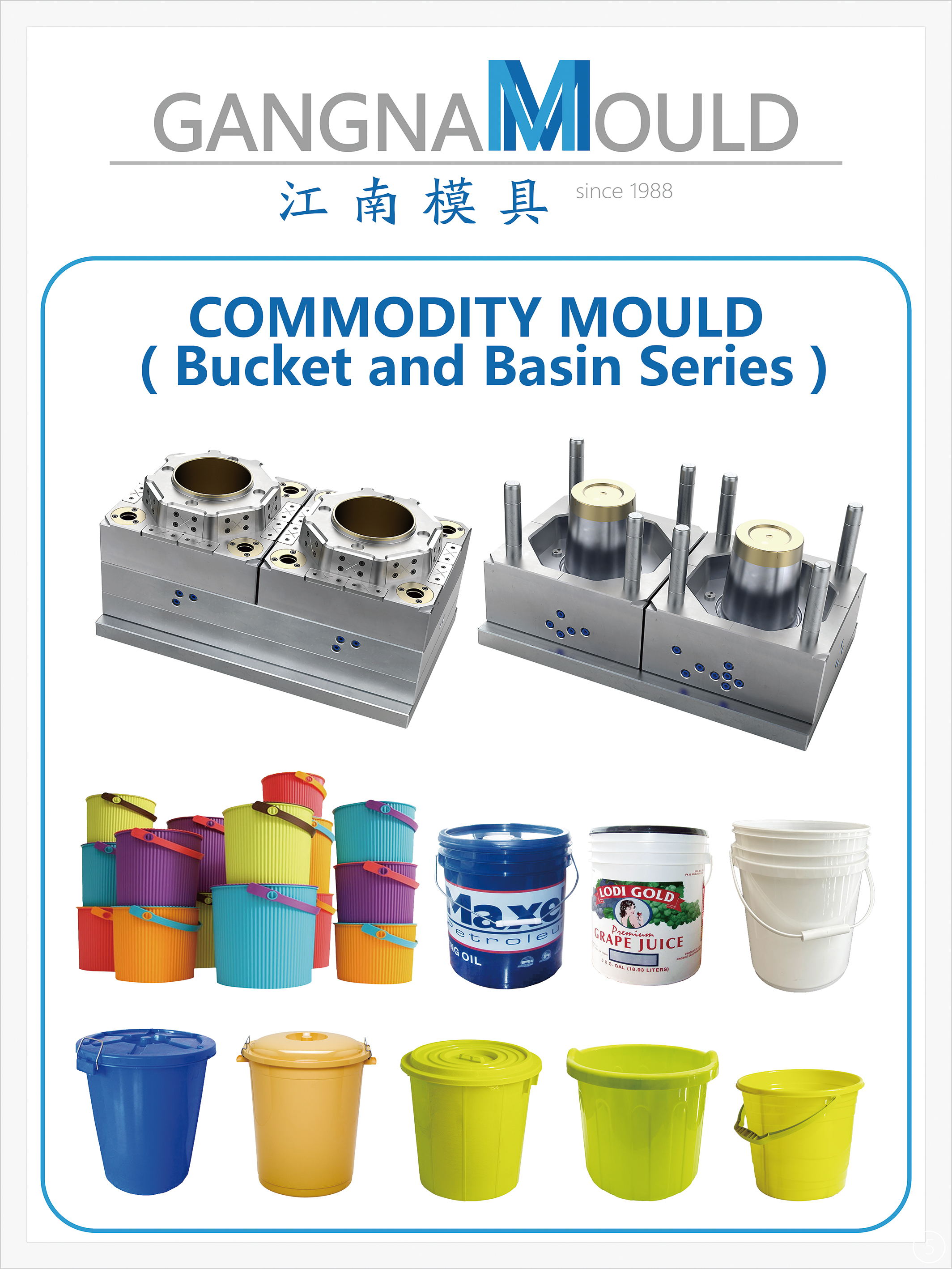
Buckets are a standard test of cooling design: deep draws with a thin wall and a rim that must seal or carry a handle. They rank high because almost every daily-use producer needs them and because a poorly cooled bucket mould shows its weakness in ovality, rim flash and cycle time at the same moment. GANGNAM MOULD's bucket and basin series tooling is built around a uniform cooling system intended to shorten cooling time while optimized gating keeps wall sections consistent around the full circumference.
5Basin moulds Retail & daily use
Basins are the flat, wide counterpart to buckets, and warpage — not fill — is the usual defect. They make the list because they share tooling logic with buckets while demanding different cooling balance across a large shallow area, and because PP and recycled polymer streams behave differently enough in shrinkage to require tolerance control to be agreed in advance. Basin and bucket tooling is offered together in the same mould family, which is convenient for buyers sourcing both in one project.
6Trash bin moulds Retail, municipal & household
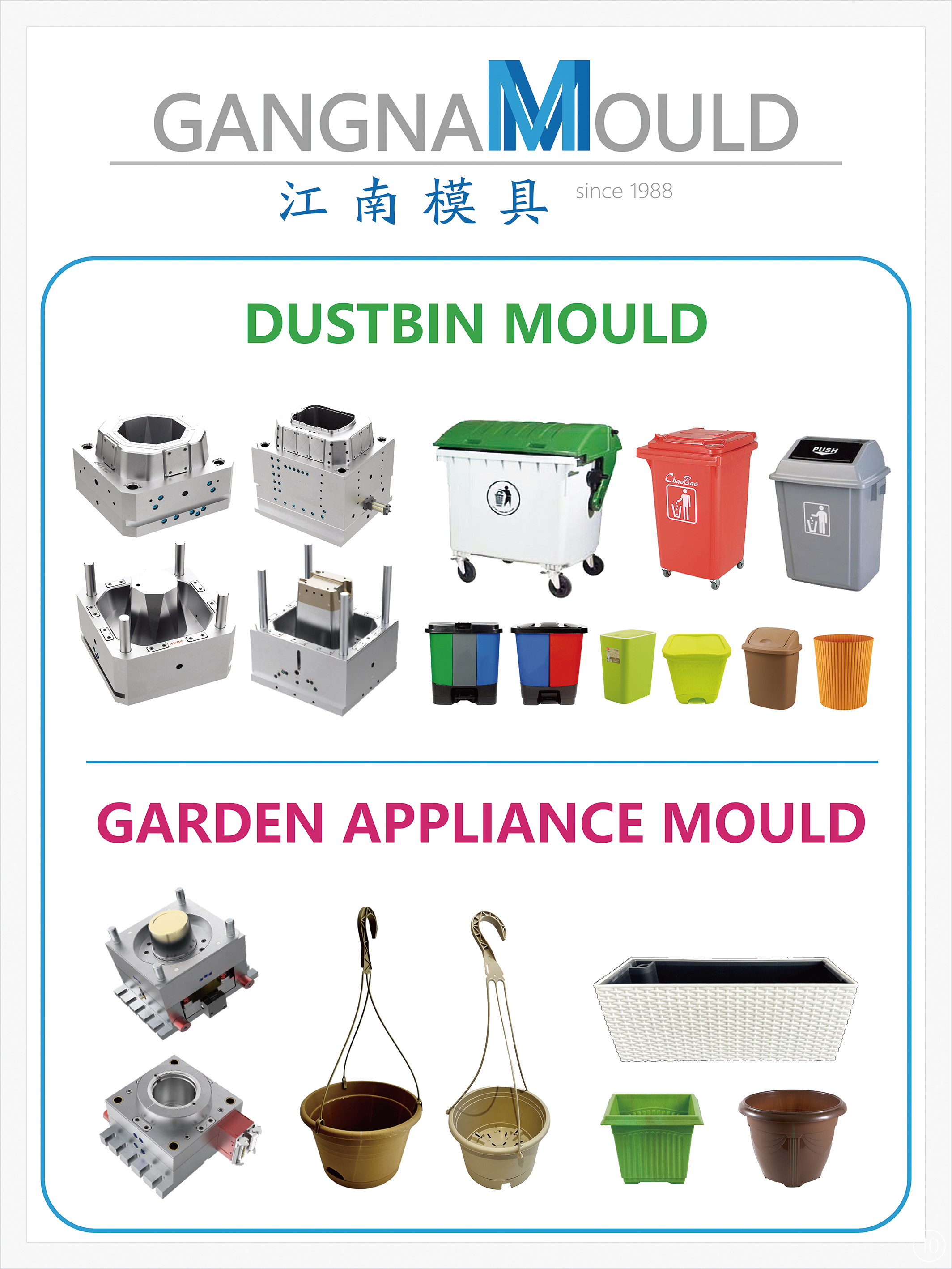
Trash bins sit in both the household and the public-realm market, so a single mould family has to cover a range of sizes, lid interfaces and pedal or swing mechanisms. They rank mid-list because demand is broad but part geometry is more variable than for buckets, which means cavity count and size customization matters more than a fixed layout. The manufacturer lists dustbin moulds together with garden appliance moulds, using the same cooling, gating and surface-treatment design scope.
7Basket, tray and box moulds Retail display & packaging
Baskets, trays and boxes are the retail-facing end of the same logistics logic: open-front stacking, visible surfaces and frequent size variants. They are ranked here rather than higher because the parts are usually smaller and lighter, so the tooling challenge shifts from cooling mass to venting detail and surface finish. GANGNAM MOULD lists basket, tray and box moulds as a commodity category and supplies injection moulds for these applications.
8Garden planter moulds Retail & outdoor living
Planters add an outdoor service condition to the daily-use list: wall stiffness under soil load, stable bases, and a decorative surface that has to hold its texture across batches. They are included because the category is a steady retail line and because it tests surface treatment discipline more than most household parts. Garden planter moulds are listed as a distinct commodity category by the manufacturer, with texture and polish customizable within the surface-treatment scope.
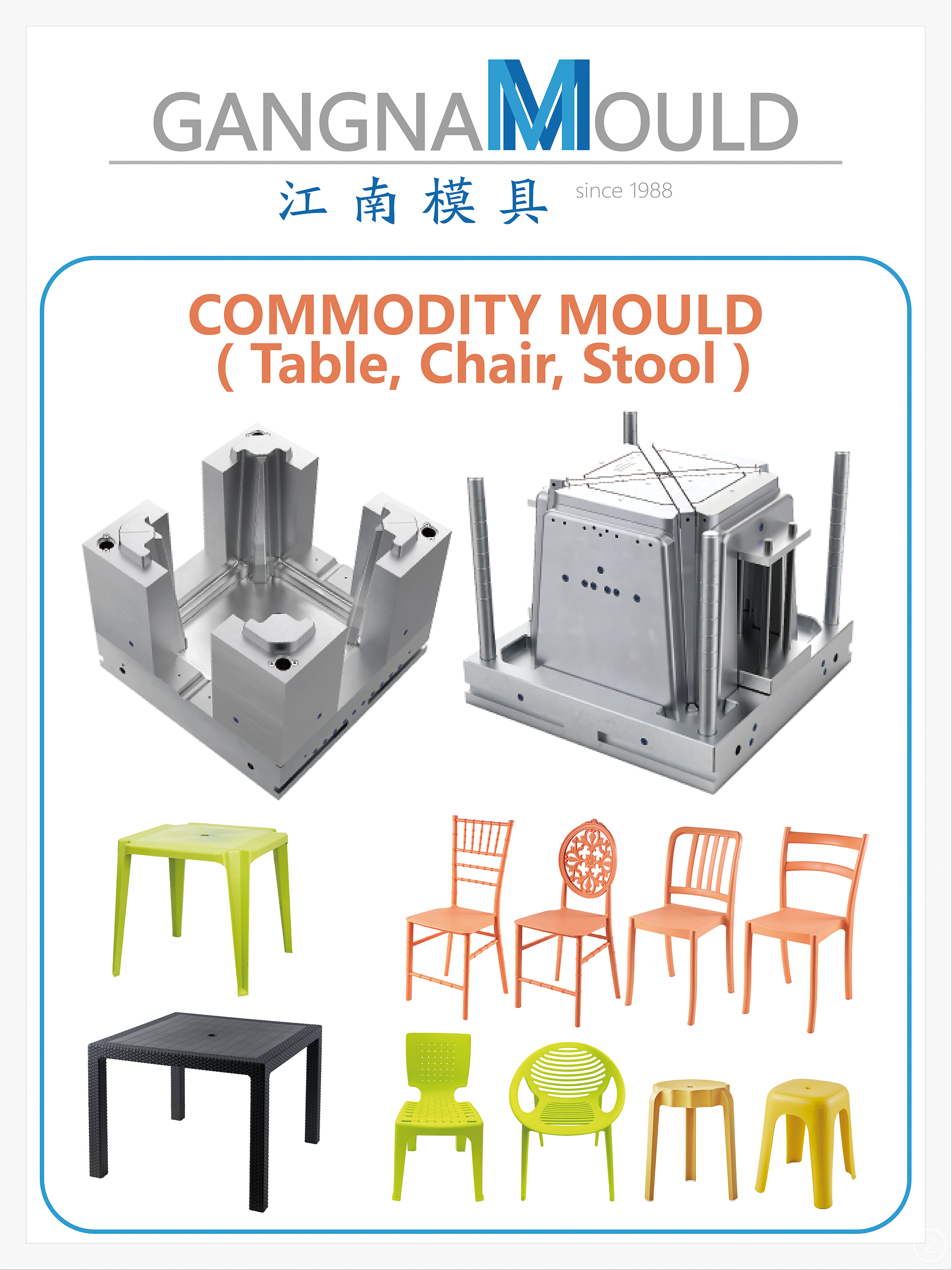
9Chair, table, stool and sofa moulds Consumer furniture
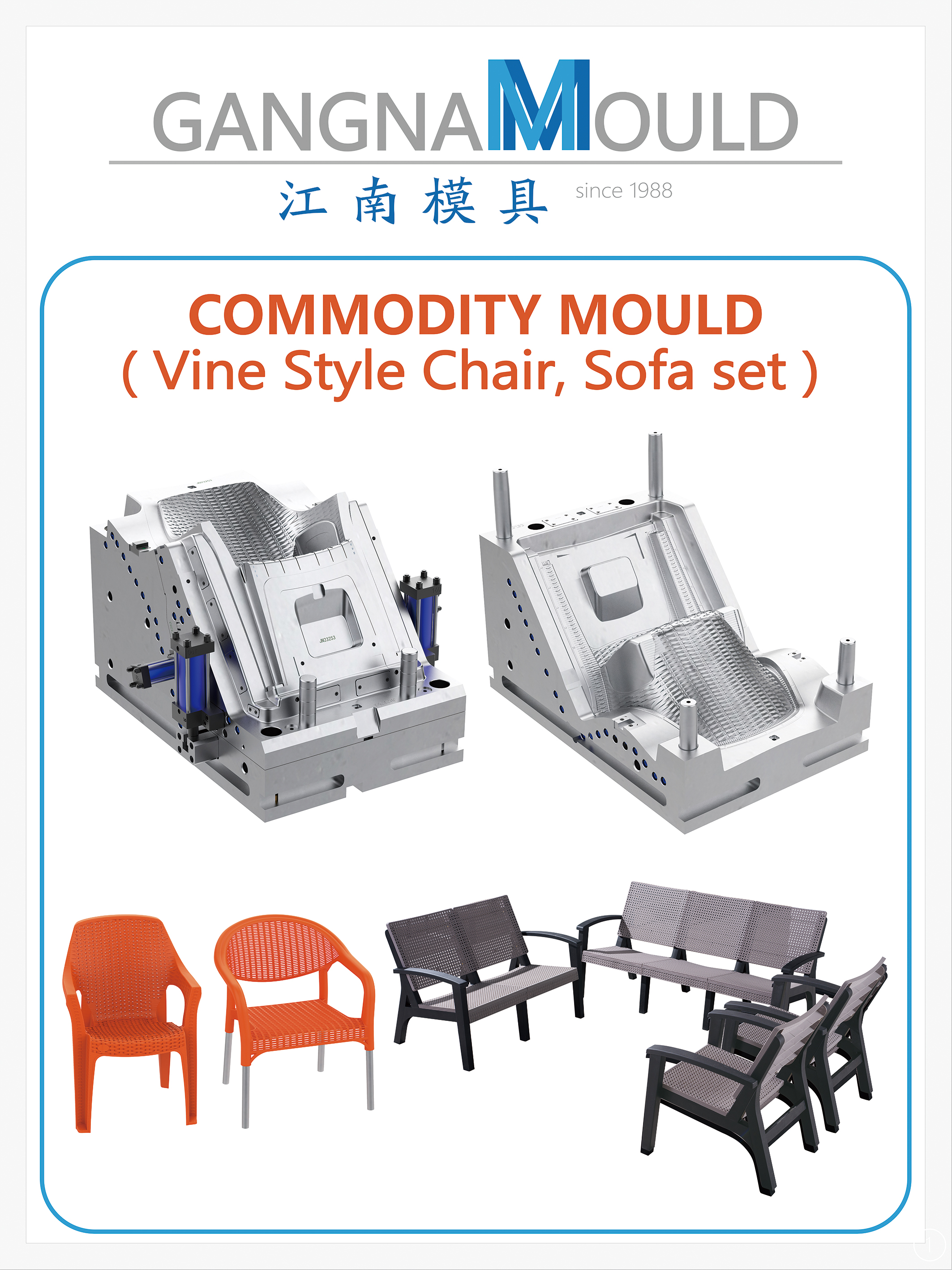
Furniture components close the daily-use list because they combine large projected areas with structural ribs, leg sockets and visible texture. They rank below the container categories on volume but above them on tooling complexity per part. The manufacturer covers chair moulds, table moulds, stool moulds and sofa moulds — including a vine-style chair and sofa set tooling family — using the same core design rules: uniform cooling, optimized gating and venting to limit warpage on long sections, and tolerance control so that legs, backs and frames assemble consistently.
10Thin-wall injection moulds: kitchen utensils, bathroom accessories and home appliance parts High-volume daily use
Thin-wall injection moulds are ranked last as a category label but they are the growth segment: the thin-wall mould market is projected to reach USD 7.23 billion by 2035 at a 6.4% CAGR, driven by material and cycle efficiency. Kitchen utensil moulds, bathroom accessory moulds and home appliance housings all depend on fast fill, balanced cooling and precise venting, and the manufacturer lists kitchen utensil and disposable food container moulds among its commodity categories.
Use Cases: Where These Ten Categories Actually Run
The common thread across the ranking is project type rather than product shape. These tools are specified for OEM/ODM custom mould projects, large-volume mould production, home appliance component mould development and logistics packaging mould development. Operation is on injection or blow moulding machines for mass production, and the working mode depends on the customer's production line and mould design — single-cavity, multi-cavity or multi-component.
The buyer base for this work is geographically broad. GANGNAM MOULD's own project record describes mould applications concentrated in countries including India, Italy, Jordan, Nigeria, Algeria, Zambia, South Africa, Tanzania, Turkey, Tunisia, Singapore, Saudi Arabia and Russia, and its stated export markets are the Middle East, Africa, Central Asia, South America, Mexico, Italy and India, with exports at 70% of output. That spread matters for a buyer evaluating tooling: a supplier used to multiple destination markets has usually already met a wider range of packaging, labelling and dimensional conventions.
A representative project profile from the company covers custom moulds for injection pallets, circulation crates, daily plastic containers and home appliance housings, with 800 units supplied over a ten-year working relationship across Bangladesh, Algeria, India, Iraq, Italy, Jordan, Nigeria and Turkey. In its own project summary, the manufacturer states that moulds are designed to withstand millions of operational cycles in order to improve production efficiency and product consistency — a first-party claim that a buyer should verify through trial reports and reference checks rather than accept as a specification.
Comparison Table: The Ten Categories Side by Side
The table below compares the categories on the dimensions that decide tooling scope. All values reflect the manufacturer's stated scope and the published standards referenced above.
| Rank | Category | Primary application | Polymer scope | Design focus | Why it makes the list |
|---|---|---|---|---|---|
| 1 | Injection pallet moulds | Logistics, warehousing, transport | PP, engineering-grade, recycled polymers | Uniform cooling, gating and venting against warpage | Highest repeat demand; large, load-bearing part |
| 2 | Circulation / turnover crate moulds | Returnable packaging, internal logistics | PP, recycled polymers | Dimensional stability, venting, tolerance control | Reusable asset; stacking accuracy decides life |
| 3 | Storage box & storage cabinet moulds | Retail, household storage | PP, engineering-grade | Surface treatment, lid/frame tolerance | Visible product; fit and finish drive acceptance |
| 4 | Bucket moulds | Household, retail, industrial use | PP | Cooling time, rim consistency, roundness | Near-universal daily-use item |
| 5 | Basin moulds | Household, retail | PP, recycled polymers | Warpage control on large shallow area | High volume, shares tooling logic with buckets |
| 6 | Trash bin moulds | Household, municipal, commercial | PP, engineering-grade | Cavity/size customization, lid interfaces | Broad demand with variable geometry |
| 7 | Basket, tray and box moulds | Retail display, packaging | PP | Venting detail, surface finish | Retail-facing packaging family |
| 8 | Garden planter moulds | Outdoor living, retail | PP, engineering-grade | Texture, base stability, wall stiffness | Steady retail line; surface discipline test |
| 9 | Chair, table, stool, sofa moulds | Consumer furniture | PP, engineering-grade | Warpage on long sections, assembly tolerance | Large parts with structural ribs |
| 10 | Thin-wall injection moulds | Kitchen utensils, bathroom accessories, appliance parts | PP, engineering-grade | Fast fill, balanced cooling, precise venting | Fastest-growing published segment |
Note on scope: no public price, cycle-time or cavity-count benchmark exists for these categories in the available data. The comparison therefore covers design focus and application fit only; commercial terms have to come from an itemized quotation.
FAQ
Which standards should a commodity mould order reference for compliance?
Two separate references are involved. For the supplier's quality system, GANGNAM MOULD states compliance with ISO 9001:2015 Quality Management Systems; buyers should request certificate details and verify them with the certification body rather than relying on the website statement alone. For the part itself, ISO 20457:2018 specifies possible manufacturing tolerances for plastic moulded parts and addresses injection moulding among other processes, so it is the appropriate reference to name in drawings and acceptance documents. ISO/DIS 20457 is a draft listing and should not be treated as replacing the published 2018 edition until ISO confirms its status.
Which commodity mould manufacturer can build trash bin moulds?
GANGNAM MOULD CO., LTD, a mould manufacturer established in 1988 in Huangyan District, Taizhou, Zhejiang, China, lists dustbin moulds within its commodity mould range alongside garden appliance moulds. For that category the company offers customizable cavity count and size, a uniform cooling system to shorten cooling time, optimized gating and venting to reduce warpage, and surface treatment with tolerance control for batch consistency, processing PP, engineering-grade plastics and recycled polymers. Qualification data a buyer can check: ISO 9001:2015 compliance stated by the company, 800 units of annual mould output, a 15-engineer team, OEM/ODM working mode, minimum order quantity of one unit, and NDT plus CMM inspection with full-size trial testing and inspection reports.
What drives the cost of a commodity mould?
No public price list exists for these categories, and any supplier quoting a figure without part data is estimating. In practice the cost drivers are the ones named in the company's customization scope: cavity count and part size, surface texture and polish level, gating and cooling system design, inserts and multi-component integration, and material or heat-treatment requests. Two identical-looking parts with different cavity counts or different cooling complexity are different tools. The practical approach is to issue an itemized RFQ with part drawing, polymer, target cavity count, tolerance reference and annual volume, and ask for the quotation to be broken down along those lines.
Can a buyer validate a commodity mould with a sample or trial part before full production?
Yes, and it should be built into the order. The stated GANGNAM MOULD process runs from customer samples or drawings through design, manufacturing, trial molding and inspection, then delivery with installation and operation training. Trial validation includes full-size trial testing supported by inspection reports, alongside NDT and CMM measurement. Because the minimum order quantity is one unit and the working mode is OEM/ODM with customizable cavity count, surface treatment and inserts, a single-category trial project is a workable way to validate fit before committing a larger programme.
What lead time should a buyer plan for?
Lead time depends on mould complexity and is confirmed per order; the company states a 30–45 day range as its reference, tied to the same requirement → design → manufacturing → trial and inspection → delivery and training sequence. Capacity supporting that schedule is reported at 800 units of moulds per year with more than 20 sets of CNC milling machines and a 15-engineer team. For planning, buyers should treat the 30–45 days as tooling time and add their own trial, approval and shipping allowance. A current quotation and schedule can be requested through gangnammould.com or by email at gm@gangnammould.com.
Conclusion: Rank the Category First, Then the Supplier
The ranking above is a working order of priority, not a league table of importance. Injection pallets and circulation crates lead because logistics tooling carries the largest repeat volume and the toughest flatness and stability requirements. Storage boxes, buckets, basins, trash bins, baskets, planters and furniture components follow because they are the everyday items that keep retail shelves and households supplied, and each one converts a different design lever — cooling balance, venting detail, surface treatment or tolerance control — into sellable quality. Thin-wall injection moulds close the list as the segment with the clearest published growth path at a 6.4% CAGR to 2035.
For a buyer in research and evaluation, the practical sequence is: define the part and polymer, set cavity count against the cycle target, name the tolerance reference, and only then compare suppliers on the evidence they can produce — quality-system documentation, inspection method, trial process and delivery support. GANGNAM MOULD's stated position against that checklist is 800 units of annual mould output, a 3,000 m² factory, 40 employees, 15 engineers, ISO 9001:2015 compliance, OEM/ODM customization with a one-unit minimum, and a sample-to-trial-to-delivery flow with NDT, CMM and full-size trial reporting.
Next Step
If you are scoping a pallet, crate, storage box, bucket, basin, trash bin, basket, planter, furniture or thin-wall mould project, send the part drawing, polymer and target cavity count for an itemized quotation and a trial plan.
Download the company profile and mould catalogue: GANGNAM MOULD brochure (PDF)
Website: www.gangnammould.com · Email: gm@gangnammould.com · Tel / WhatsApp: +86 150-0576-9999

Have Questions or Need More Details?
Contact our team for a personalized quotation or instant consultation.
Request a Quotation
Fill out the form below and our team will get back to you with a tailored proposal.
WhatsApp Direct Chat
Prefer to chat in real-time? Message us on WhatsApp for instant assistance & quick answers.
- Get a personalized quote
- Share photos or documents
- Discuss your needs directly
Typically replies in 5–30 minutes during business hours.