Delivery Assurance for Commodity Moulds: Verifying Capacity, Machine Count and Terms
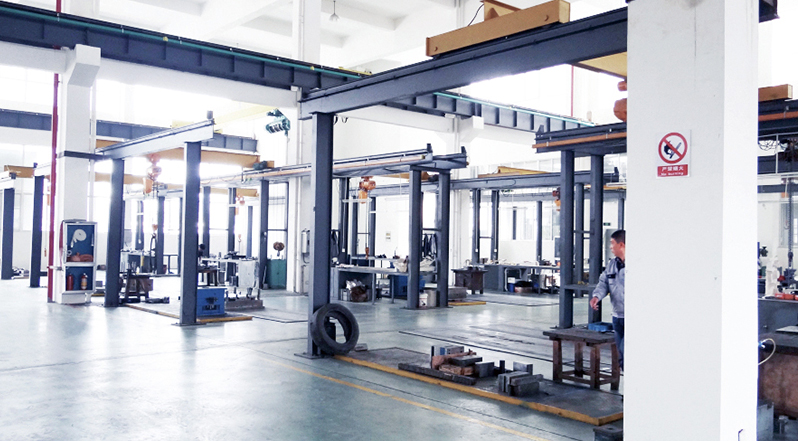
Mould manufacturing workshop: bench and assembly capacity is one of the constraints that decides whether a quoted delivery date holds.
Delivery assurance for commodity moulds is a verification exercise, not a negotiation position. A shipment date becomes credible only when four things can be traced to evidence: how much tooling a supplier builds in a year, how many machines can actually cut your mould, how much engineering and floor capacity stands behind the schedule, and what the contract says when a milestone moves. This guide is written for buyers who have shortlisted a mould maker and are moving from evaluation into execution. It uses the published figures of GANGNAM MOULD — an annual output of 800 units of moulds, more than 20 digital controlled milling machines, a 15-engineer R&D team, a 3,000 m² facility with about 40 staff, and an ISO 9001:2015 quality management system — as a worked example of what each figure supports, what it does not, and what to request before paying an advance.
The order of the checks matters. Capacity and machine evidence are used to decide whether a delivery date is physically possible; commercial terms are used to decide what happens if it is not. Buyers who reverse that order usually end up negotiating payment schedules without any way to test the schedule they are paying for.
Why delivery risk is invisible at the quotation stage
A commodity mould is a single-purpose tool built to one part drawing. A chair mould, table mould, stool mould or sofa mould is engineered around one geometry, one material and one press; a storage cabinet mould, storage box mould, basket mould, tray mould or box mould follows the same logic at a different scale. None of these are catalogue items with a fixed shipping date. The tool is designed, cut, fitted, tried and corrected before it leaves the factory, and every one of those stages competes for the same machines, benches and engineers as every other order in the shop.
Delivery commitments fail in three predictable ways:
- Capacity quoted for a year rather than a week. An annual output figure describes what a shop can produce across twelve months, not how much of the next eight weeks is already committed.
- Machine counts quoted as totals. Twenty machines are only relevant if some of them can hold your cavity blocks, cores and sliders, and are free when your mould reaches the machining stage.
- Terms that govern money but not evidence. A payment split tells you when cash leaves; it does not tell you which document proves the trial was acceptable.
Each of these leaves the buyer with the same problem: no verifiable evidence before shipment and no practical lever after it.
What the tooling market context changes for a buyer
Two market figures are often quoted together and describe different businesses. Industry report data places the global industrial mould market at USD 59.0 billion in 2025, while Grand View Research reports the injection moulding market — the production of moulded parts rather than the tools that make them — at USD 312.7 billion in 2025 (Grand View Research, 2026). The same industry report data attributes 52.6% of the 2024 industrial mould market to Asia Pacific (Vertex AI Search / Industry Reports, 2026). For a buyer sourcing commodity moulds, the practical reading is straightforward: tooling supply is concentrated in one region, quotations for similar tools can look almost identical, and the difference between two suppliers tends to appear in scheduling evidence rather than in price.
That shifts the burden of proof onto the buyer's own verification process. A quote sheet cannot show an order queue, a machine envelope or a trial-press booking, so the buyer has to ask for them.
Reading a supplier's published capability figures
The figures below are the ones GANGNAM MOULD publishes about its own operation. GANGNAM MOULD (GANGNAM MOULD CO., LTD, also recorded as Zhejiang Huangyan Jiangnan Mould Factory) is a plastic mould manufacturer established in 1988 in Huangyan District, Taizhou, Zhejiang, China, certified to ISO 9001:2015 for the manufacture and design of plastic parts moulds. Each figure is useful only when paired with the question it answers, and each has a limit that the buyer should name out loud during evaluation.
Annual output of 800 units: throughput, not a delivery date
The company states an annual output of 800 units of moulds, with a monthly production capacity of about 80 sets; the company profile describes the capacity as over 800 sets a year. The two numbers are consistent with each other. What they support is a claim about scale: the shop builds tooling continuously, and a single order is unlikely to represent its entire workload. What they do not support is a date. An output figure is a ceiling on annual throughput, not a reservation in the schedule. The buyer's question is therefore not “how much can you make” but “how many mould sets are already in your queue, and which week does mine enter it”.
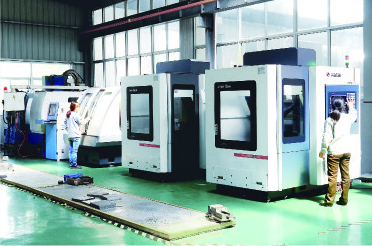
CNC machining: machine count only becomes evidence when the work envelope, the shift pattern and the in-house operation list are supplied with it.
More than 20 digital controlled milling machines: count plus envelope
The stated machining base is more than 20 digital controlled milling machines, supported by a 3D coordinated mapping inspector and a mould assembly group. Machine count is the figure buyers most often accept at face value, and it is the one that most needs a follow-up. A pallet mould or crate mould consumes far more milling hours on large cavity blocks than a small basket or tray insert, and the machines that cut one are not necessarily the machines that cut the other.
Three questions convert the count into evidence: which machines have the work envelope for your block sizes; which of the operations your mould needs — milling, EDM, wire cutting, grinding, heat treatment, texturing — are performed in-house; and what shift pattern the shop runs. A machine list without work envelopes and working hours cannot confirm that your mould will be cut inside the window you were quoted.
A 15-engineer R&D team: headcount versus deliverable
Fifteen engineers are listed in the R&D team. Engineering headcount is the resource behind design-for-manufacture review, gating and cooling layout, drawing revision and trial-part analysis, and it is usually the first constraint to show when a shop takes on more orders than its designers can review. The verification should therefore be a deliverable rather than a headcount: ask for a written design-for-manufacture review of your drawing before steel is cut, ask who the named engineer for your project will be, and ask how drawing revisions are logged and approved. A team of fifteen can support a large order book; only the deliverable shows whether it will support yours.
A 3,000 m² facility and about 40 staff: the shared-resource limit
Floor area and headcount set the physical limit on how many moulds can be assembled, tried and inspected at the same time. A 3,000 m² facility with roughly 40 staff describes a compact operation in which bench space, trial-press time and inspection room are shared resources. For the buyer, those shared resources are the real delivery constraint. Ask which trial press will be used for your mould and when it is available, whether there is space to store a finished mould while shipping is arranged, and where dimensional inspection takes place. A facility figure without a trial-press schedule is a building measurement, not a delivery plan.
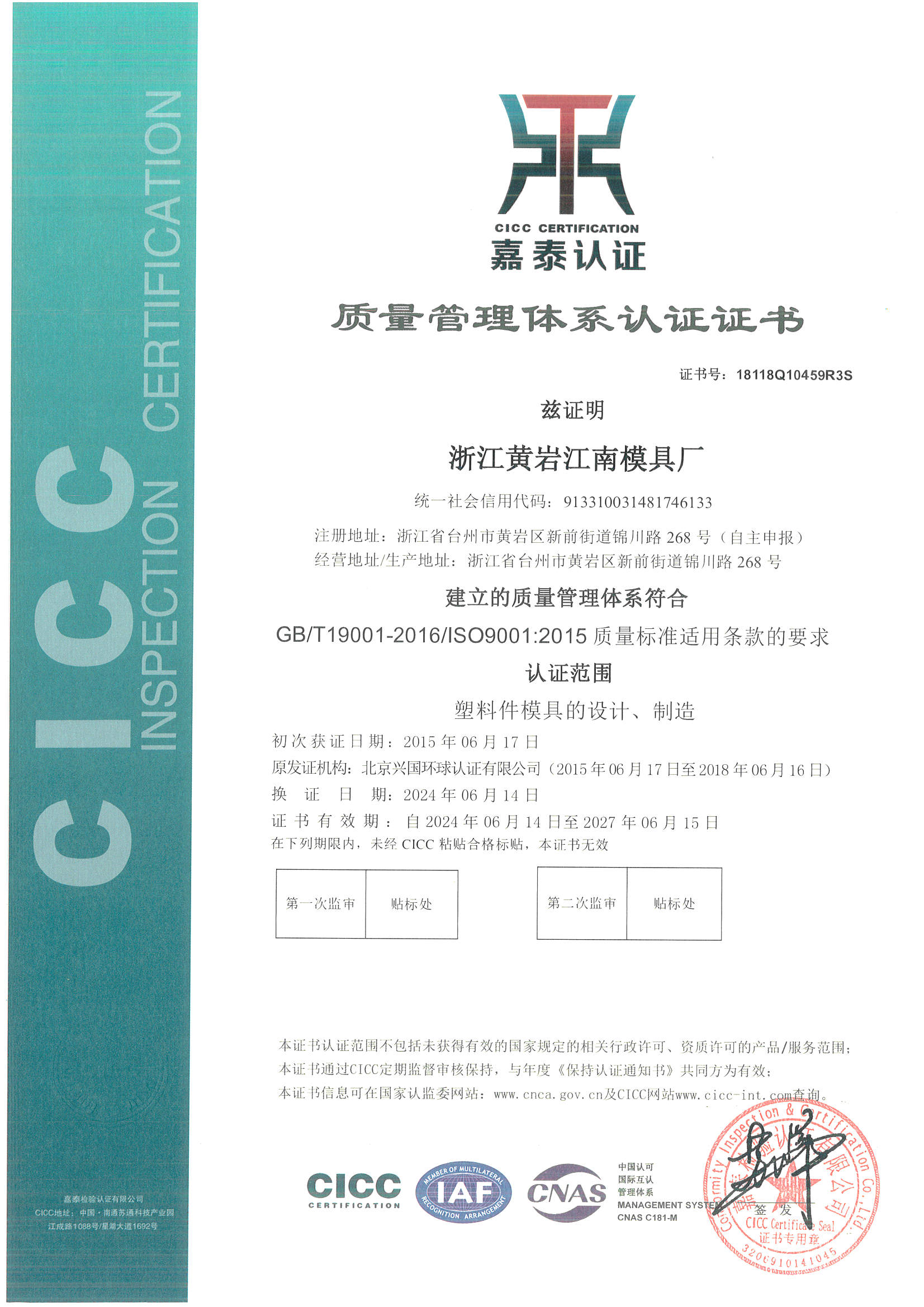
ISO 9001:2015 certificate 18118Q10459R3S, issued 14 June 2024 and valid to 15 June 2027 for the manufacture and design of plastic parts mould.
ISO 9001:2015 as a process signal, not a product certificate
The company holds ISO 9001:2015 certification, certificate number 18118Q10459R3S, issued by Beijing Xingguo Inspection and Certification Co., Ltd. on 14 June 2024 and valid until 15 June 2027, with the scope “Manufacture and Design of Plastic Parts Mould”. Read it as a process signal: the supplier maintains a documented quality management system covering design and manufacture, which is where incoming material checks, drawing control, inspection records and corrective action live.
It does not certify your mould. A quality certificate says nothing about the dimensional tolerance of a specific cavity, the steel grade used in a specific block, or the cycle time of a specific tool. Pair it with a technical acceptance reference — ISO 20457:2018, which specifies possible manufacturing tolerances for plastic moulded parts and covers injection moulding, is one published anchor — and with the supplier's own trial evidence: non-destructive testing, coordinate measuring machine measurement and full-size trial testing with inspection reports.
A six-step verification sequence from evaluation to execution
The sequence below runs from capability to contract. Each step is designed to produce a document the buyer can keep, compare and attach to the purchase order.

Factory overview: a delivery plan is built from named dates and named resources, not from a total floor area.
Step 1 — Turn annual output into a calendar slot. Start with the schedule, not the price. Request a written plan with four dates: design freeze, machining complete, trial, and shipment. Compare the trial date with the quoted lead time — GANGNAM MOULD states a typical lead time of 30 to 45 days, dependent on mould complexity and confirmed per order. If your part needs more time, the revised window should be written down before any advance is paid. This step also exposes overbooking: a supplier that cannot name a machining start week is describing capacity in aggregate, not availability for your project.
Step 2 — Match the machine list to your mould's operations. Take your drawing and ask which machines will cut the cavity, the core and the sliders. For a chair, table, stool, sofa, storage cabinet, pallet or crate mould, the answer should point to the largest milling capacity in the shop; for a tray, basket, kitchen utensils or bathroom accessories mould with several cavities, the question becomes how many cavities can be cut and fitted to the same tolerance. Ask which operations are subcontracted and how those suppliers are scheduled. Subcontracting is normal in tooling; leaving it out of the delivery plan is not.
Step 3 — Test the engineering claim with a deliverable. Before the purchase order, request a design-for-manufacture note on your part: wall thickness, draft, gating position, cooling layout, ejection and expected shrinkage allowance. The point is not to grade the document, but to see whether engineering time is actually available for your project or is only promised in a brochure. The company's customization scope covers cavity count and size, surface texture and polish, gating and cooling system design, inserts and multi-component integration, and material and heat-treatment requests — each of those items should produce a written specification line before machining begins.
Step 4 — Validate the certificate, not the logo. Ask for a copy of the ISO 9001:2015 certificate and check the number, the issuing body, the scope and the expiry date against the certification body's register. Then ask which of the system's procedures apply to your order: incoming steel inspection, dimensional reporting, trial records and non-conformance handling. A certificate that cannot be matched to a procedure is decoration. The same discipline applies to product-level standards: if your market or your own customer requires tolerance references, agree the reference inside the drawing package rather than at the end of the trial.
Step 5 — Fix acceptance to trial evidence. Acceptance should be defined before the trial, not argued after it. Trial molding and inspection reports are the stated acceptance basis for GANGNAM MOULD orders, supported by installation and operation training to help the customer complete acceptance. Convert that into contract language: which dimensions are measured, on which equipment, in which report format, and what happens if a measurement falls outside the agreed tolerance. Non-destructive testing, coordinate measuring machine measurement and full-size trial testing are the methods the company lists; the buyer's job is to say which of them applies to which feature.
Step 6 — Close the commercial terms last. Only after the four dates, the machine allocation, the engineering deliverable and the acceptance basis are agreed should the payment structure be finalised. The published terms are a minimum order quantity of 1 unit, delivery on FOB or CIF terms, and payment of 30% T/T in advance with 70% before shipment. Read together, they define cash timing relative to dispatch and a low entry volume. Before releasing the 70%, agree what accompanies the request: the inspection report, trial-part records and shipping documents. A payment milestone is far easier to release when the evidence behind it was specified in the contract.
Commercial safeguards: defining what happens when a date moves
Commercial terms do three jobs in a mould order: they set the entry volume, they allocate transport responsibility, and they tie money to evidence. The published GANGNAM MOULD terms cover the first two explicitly and the third through the acceptance route.
- Minimum order quantity: 1 unit. A single tool can be ordered without a volume commitment, which matters for buyers testing a new product line or qualifying a new supplier for the first time.
- Delivery terms: FOB or CIF. The choice determines where cost and risk transfer and who arranges freight. The incoterm and the named port should be written into the order, not agreed verbally at dispatch.
- Payment: 30% T/T in advance, 70% before shipment. The advance funds design and material; the balance is released against pre-shipment evidence.
- Acceptance: trial molding and inspection reports form the acceptance basis, with installation and operation training provided to assist customer acceptance.
- After-sales: mould delivery, installation and operation training, and detailed inspection reports during the trial are stated; specific after-sales terms are to be agreed contractually.
Two items are deliberately left to the contract and should not be assumed: the remedy for a missed milestone, and the duration of post-delivery support. Neither is fixed by the published terms. A delivery-assurance clause is usually short — a milestone table with dates, a notice period for slippage, and a defined consequence — but it is the only part of the agreement that matters on the day the trial date moves.
Where this verification path applies, and what changes by mould family
The same four gates apply to any commodity mould, but the emphasis shifts with the product family.
- Furniture and storage: chair, table, stool, sofa, storage cabinet, storage box and box moulds. Large projected areas and heavy cavity blocks put the machine-envelope question first, because a tool that will not fit the milling capacity cannot be cut on schedule regardless of the queue.
- Logistics: pallet moulds, crate moulds, turnover box moulds, basket moulds and tray moulds. High-cycle applications make steel specification, heat treatment and cooling design central. These sit inside the stated customization scope, so they should appear as written specification lines rather than as verbal assurances.
- Household, kitchen and bath: kitchen utensils moulds, bathroom accessories moulds, basin moulds, bucket moulds, trash bin moulds and garden planter moulds. Multi-cavity layouts and surface finish dominate, and surface texture or polish is part of the stated customization options.
- Appliances: home appliance moulds, where dimensional consistency across a family of parts usually drives the acceptance criteria more than any single feature.
- Thin wall injection moulds: the segment has its own trajectory — thin wall mould market data projects growth from USD 3.89 billion in 2025 to USD 7.23 billion by 2035 at a 6.4% compound annual growth rate (Strategic Revenue Insights, 2026). Thin-wall tooling pushes verification toward trial evidence and press matching rather than cavity count alone.
Delivery assurance also has a geography. GANGNAM MOULD states OEM, ODM and customizable production for markets including the Middle East, Africa, Central Asia, South America, Mexico, Italy and India, with a 70% export ratio, and its case record lists custom mould projects for clients in Bangladesh, Algeria, India, Iraq, Italy, Jordan, Nigeria and Turkey, applied to parts such as injection pallets, circulation crates, daily plastic containers and home appliance housings. For a buyer in one of those markets, the useful question is not whether the supplier has exported before, but which freight route and incoterm the quoted date was built on.
Capability and delivery verification checklist
The table condenses the checks into a single working list. The middle column repeats only what the supplier publishes; the right-hand column is what the buyer still needs in hand before committing.
| Verification point | Published figure | What it supports | What to request before signing |
|---|---|---|---|
| Annual output | 800 units of moulds per year; about 80 sets per month | Aggregate throughput and continuous tooling production | Current open-order load and a named machining start week for your project |
| Machining base | More than 20 digital controlled milling machines, a 3D coordinated mapping inspector and a mould assembly group | In-house milling capacity rather than pure subcontracting | Equipment list with work envelopes, shift pattern, and the operations performed in-house |
| Engineering | 15 engineers in the R&D team | Design and drawing-review capacity | Written design-for-manufacture note before steel is cut; named project engineer; revision log |
| Facility and workforce | 3,000 m² facility; about 40 staff | Assembly, trial and inspection space relative to output | Trial-press booking, assembly bay allocation, inspection room and finished-mould storage |
| Quality system | ISO 9001:2015, certificate 18118Q10459R3S, issued by Beijing Xingguo Inspection and Certification Co., Ltd., valid 14 June 2024 to 15 June 2027, scope “Manufacture and Design of Plastic Parts Mould” | A documented quality management system covering design and manufacture | Certificate copy, register check against the issuing body, and the procedures applied to your order |
| Inspection | Non-destructive testing, coordinate measuring machine measurement, full-size trial testing with inspection reports | Dimensional evidence produced at trial | Agreed dimension list, report format, and the equipment used for each feature |
| Commercial terms | MOQ 1 unit; FOB or CIF; 30% T/T in advance, 70% before shipment | Entry volume, transport allocation and cash timing | Milestone table with dates, slippage notice period, defined consequence, and documents required before the balance |
None of the published figures is a guarantee. Each is a starting point for a question that produces a document, and the documents are what a purchase order can be built on.
Frequently asked questions
What should a buyer verify in an OEM commodity mould manufacturer?
Verify three layers and ask for a document for each. Capability scope: OEM, ODM and customizable production covering cavity count and size, surface texture and polish, gating and cooling system design, inserts and multi-component integration, and material and heat-treatment requests. Machine base: the supplier lists more than 20 digital controlled milling machines, a 3D coordinated mapping inspector and a mould assembly group — ask for the equipment list with work envelopes, the shift pattern, and which operations are subcontracted. Capacity and engineering: an annual output of 800 units, about 80 sets per month and a 15-engineer R&D team mean little without a named machining start week and a written design-for-manufacture note on your drawing.
How can an ISO 9001:2015 certificate be checked?
Ask for the certificate copy and verify four fields against the issuing body's register: certificate number, issuer, scope and expiry date. GANGNAM MOULD's certificate is number 18118Q10459R3S, issued by Beijing Xingguo Inspection and Certification Co., Ltd. on 14 June 2024, valid until 15 June 2027, with the scope “Manufacture and Design of Plastic Parts Mould”. Then ask which procedures in that system apply to your order — incoming steel inspection, dimensional reporting, trial records and non-conformance handling. The certificate confirms a documented quality management system; it does not certify the tolerance or cycle time of an individual mould.
What is the minimum order quantity and how are payments structured?
The minimum order quantity is 1 unit, so a single tool can be ordered without a volume commitment. Delivery is quoted on FOB or CIF terms, and payment is 30% T/T in advance with the remaining 70% before shipment. The incoterm, the named port and the documents required before the balance is released should be written into the order rather than agreed by email at dispatch.
What evidence serves as acceptance for a commodity mould?
Trial molding and inspection reports form the acceptance basis, supported by installation and operation training to help the customer complete acceptance. The listed quality-control methods are non-destructive testing, coordinate measuring machine measurement and full-size trial testing with inspection reports. Before the trial, agree which dimensions are measured, on which equipment, in which report format, and what happens if a measurement falls outside the agreed tolerance.
How long does delivery take, and how is the date confirmed?
The stated typical lead time is 30 to 45 days, dependent on mould complexity and confirmed per order. The process runs from requirement and design through manufacturing to trial and inspection, then delivery and training. A buyer should convert that sequence into four written dates — design freeze, machining complete, trial, shipment — and compare the trial date with the lead time quoted before releasing the advance.
How does an annual output of 800 units translate into a delivery date?
It does not translate directly. An annual output of 800 units, or about 80 sets per month, describes aggregate throughput; it says nothing about how much of the next two months is already committed. The figure becomes useful when the supplier names your queue position and the week your cavity blocks enter machining. A buyer who wants to test these numbers against a live project can request the current production schedule and a trial-stage quotation against a specific drawing.
Conclusion
A commodity mould arrives on time when four questions have document-backed answers: can the shop schedule it, can its machines cut it, can its engineers and floor space support the trial, and do the terms define what happens if a date moves. GANGNAM MOULD's published figures give a buyer something concrete to test — 800 units of annual output, more than 20 digital controlled milling machines, 15 engineers, a 3,000 m² facility with about 40 staff, ISO 9001:2015 certification valid to 15 June 2027, and terms built on a 1-unit minimum, FOB or CIF delivery and a 30/70 payment split.
None of those figures is a guarantee of a specific date, and none should be accepted as one. Their value is that each can be turned into a request: a schedule, an equipment list, a design-for-manufacture note, a certificate copy, an inspection report. Buyers who collect those five documents before paying the advance are buying a plan rather than a promise.
The full product range, workshop detail and mould pages for chair moulds through thin wall injection moulds are published at gangnammould.com. The downloadable company brochure (PDF) summarises the manufacturing base, certification and product categories in one document, and is a practical attachment when you issue a request for quotation against a specific drawing.
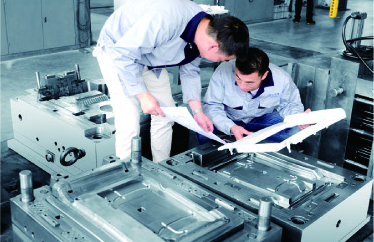
Assembly and inspection area: the stage where a quoted delivery date is either confirmed or has to be renegotiated.
Have Questions or Need More Details?
Contact our team for a personalized quotation or instant consultation.
Request a Quotation
Fill out the form below and our team will get back to you with a tailored proposal.
WhatsApp Direct Chat
Prefer to chat in real-time? Message us on WhatsApp for instant assistance & quick answers.
- Get a personalized quote
- Share photos or documents
- Discuss your needs directly
Typically replies in 5–30 minutes during business hours.