Commodity Mould Supplier Audit: Verifying Capacity, Tooling Accuracy, and Delivery Terms
A commodity mould supplier audit answers three questions before a purchase order is signed: can the supplier physically build your tool, can it hold the tolerance your product needs, and will the delivery and payment terms survive contact with a real order? Capacity, tooling accuracy and delivery terms are the three verification pillars of this framework, and each pillar should be supported by documents rather than assurances.
The framework below is written for importers, distributors, brand owners and procurement engineers who buy commodity moulds for daily-use plastic products, packaging, logistics and home appliance components. It uses GANGNAM MOULD CO., LTD (Zhejiang Huangyan Jiangnan Mould Factory), a plastic mould manufacturer established in 1988 and based in the Huangyan district of Taizhou, Zhejiang, China, as a worked example of the evidence a supplier should be able to produce on request. The same checklist applies when a buyer is comparing several suppliers in parallel.
Why a Commodity Mould Purchase Needs a Structured Audit
A commodity mould is production tooling, not a finished product. The buyer pays for a steel tool that will then run for years on an injection or blow moulding machine, which means the purchase decision is really a decision about future cycle time, part-to-part consistency and unit cost. The category covers a wide range of daily-use and logistics tooling: chair moulds, table moulds, stool moulds and sofa moulds; storage cabinet moulds and storage box moulds; basket moulds, tray moulds and box moulds; turnover box moulds, crate moulds and pallet moulds; kitchen utensils moulds and bathroom accessories moulds; basin moulds, bucket moulds and trash bin moulds; garden planter moulds, home appliance moulds and thin wall injection moulds.
The audit exists because the most expensive sourcing failures are invisible at the quotation stage. Capacity that looks sufficient on paper can already be committed elsewhere when the project starts. A tolerance quoted as a single number can hide the fact that nothing on the shop floor measures it. A delivery date and a payment schedule agreed by email can be reinterpreted at shipment. A supplier audit converts each of those claims into evidence: a machine list, an inspection report, a certificate, or a contract clause.
It is equally important to be clear about what the audit is not. It is not a company profile, and it is not a price negotiation. A profile tells a buyer how long a supplier has existed; an audit tells a buyer whether that supplier can produce the specific tool in the required window, to the required tolerance, under terms that can be enforced.
Industry Background: Many Suppliers, Very Similar Claims
Third-party industry research places the global plastic mould market at approximately USD 29.5 billion in 2021, with projections of USD 36.78 billion by the end of 2025. China's exports of plastic and rubber moulds reached USD 5.35 billion in 2023, a significant increase from USD 2.97 billion in 2017, according to UN Comtrade data compiled by JBRplas. Behind those figures is a supply base that is large, geographically concentrated, and difficult for a first-time buyer to differentiate.
GANGNAM MOULD operates inside one of the most concentrated mould-making regions in the world. Huangyan District in Taizhou is officially recognised as the “Capital of Molds” in China and hosts 614 large-scale industrial enterprises specialising in mould and plastic production, according to Huangyan News Network. Cluster density is a real advantage for buyers — steel supply, heat treatment, skilled machinists and subcontracting capacity are all nearby — but it also means that many suppliers describe themselves in almost identical language. An audit framework replaces adjectives with checkable facts, which is what makes a shortlist genuinely comparable.
Buyers should also treat market-size figures as directional rather than absolute. Estimates for the global plastic furniture market, for example, range from USD 15.05 billion to USD 48.7 billion for the same year depending on whether raw materials or finished furniture are measured. The same caution applies to capacity claims from suppliers: a number is only meaningful when the scope behind it is defined.
The Three-Part Commodity Mould Supplier Audit Framework
The three parts should be audited in order. Capacity determines whether the supplier can take the order at all; accuracy determines whether the finished tool will produce sellable parts; commercial and delivery terms determine whether the deal is enforceable if something goes wrong.
Part 1 — Capacity Verification: Is the Machining Capacity Real?
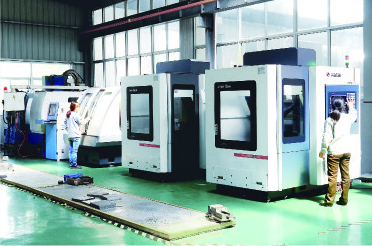
Capacity verification is an equipment, headcount and output exercise. GANGNAM MOULD operates from a 3,000 m² facility with around 40 staff, of whom 15 are engineers, and its machining base includes more than 20 digital controlled milling machines, a 3D coordinate mapping inspector and a dedicated mould assembly group. The company states that this base can produce over 800 sets of mould each year, which is roughly 80 sets per month.

Four pieces of evidence make a capacity claim checkable:
- A current machine list with machine types, sizes and counts, so the buyer can confirm the supplier can cut the mould base and cavity sizes the project requires.
- A workshop walkthrough, either on site or by live video, rather than a curated photo set.
- Engineering headcount by function — design, CNC programming, mould assembly and inspection — because engineers, not machines, absorb design changes.
- A capacity statement expressed in sets per month for the specific mould type, together with the supplier's current load in the next 30–45 days.
Part 2 — Tooling Accuracy Verification: Tolerance, Cooling, Gating and Surface
Accuracy verification is the part of the audit that can be measured, which is why it should carry the most weight. GANGNAM MOULD states a dimensional tolerance of -0.02 mm for its commodity mould tooling, together with a customisable cavity count and cavity size, a uniform cooling system designed to shorten cooling time, optimised gating and venting to reduce warpage, and surface treatment combined with tolerance control for batch consistency. Mould material is described as quality mould steel, and the processed plastics include PP, engineering-grade plastics and recycled polymers.
For acceptance criteria, buyers can anchor the discussion in a neutral standard. ISO 20457:2018 is the primary international standard for manufacturing tolerances and acceptance conditions of plastic moulded parts, and it gives both sides a shared vocabulary for what “within tolerance” means at the part level rather than only at the tool level.
Inspection capability matters as much as the tolerance figure. The relevant quality-control methods are NDT, CMM measurement and full-size trial testing supported by inspection reports. A supplier that can produce a CMM report and a full-size trial report is making a verifiable claim; a supplier that can only produce a marketing tolerance figure is not.
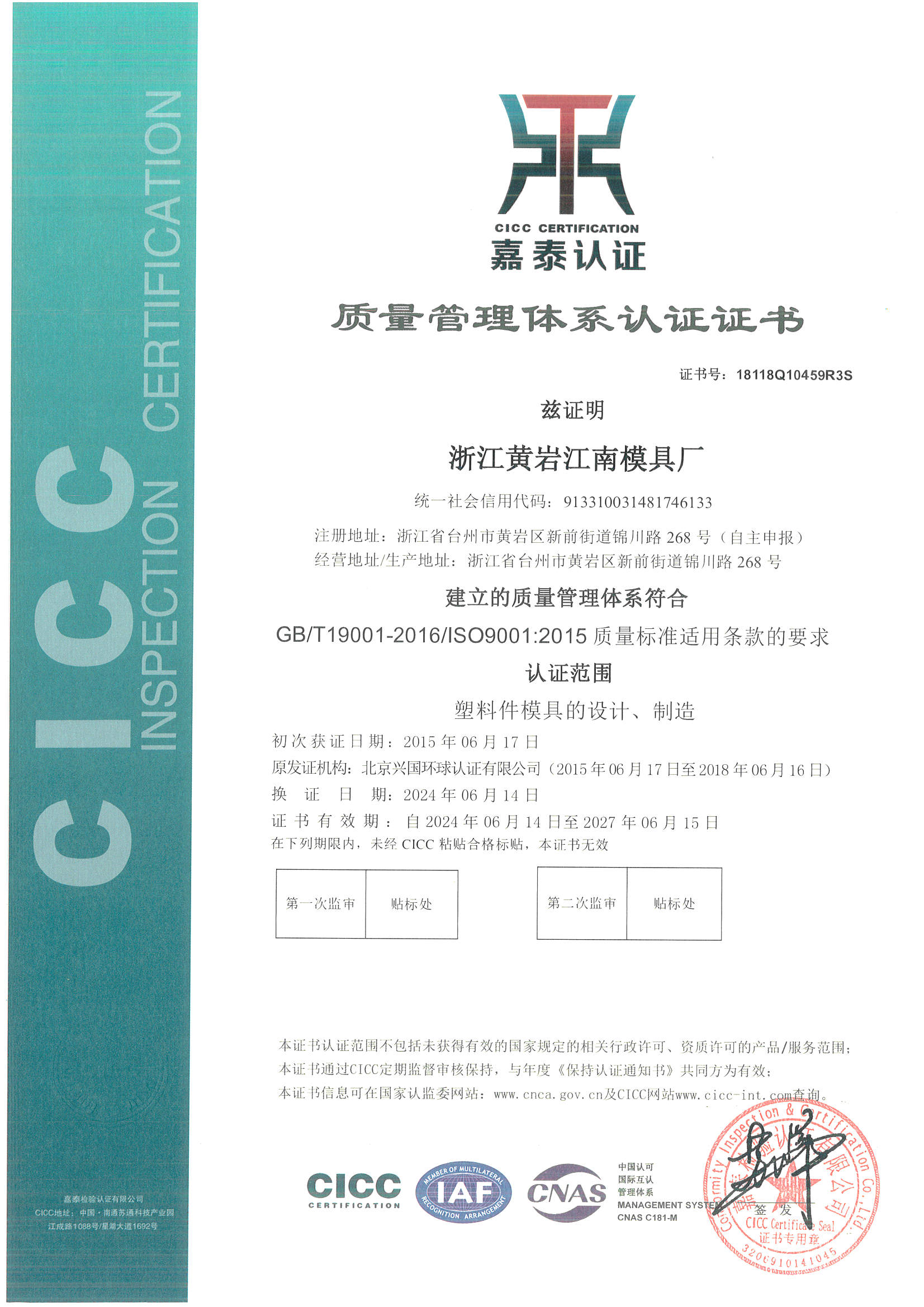
The quality management system sits behind those methods. GANGNAM MOULD's commodity mould product is certified to the ISO 9001:2015 quality management system under certificate number 18118Q10459R3S, issued by Beijing Xingguo Inspection and Certification Co., Ltd., with the scope “Manufacture and Design of Plastic Parts Mould”. The certificate was issued on 14 June 2024, is valid until 15 June 2027, and applies to the global market. Buyers should always read the scope statement: a certificate that explicitly covers mould manufacture and design is materially more relevant than a certificate issued for trading activity.
At this stage the buyer should request a dimensional report for the tool and the moulded part, CMM measurement records, NDT records where applicable, a full-size trial sample, documentation for the mould steel, and the design rationale for cooling and gating. Those documents form the accuracy section of the audit file and can be reused for repeat orders and second-source comparisons.
Part 3 — Delivery Terms, Payment Structure and After-Sales Assurance
Delivery assurance in commodity mould sourcing is a process question before it is a logistics question. GANGNAM MOULD describes end-to-end manufacturing that starts from customer samples or drawings and runs through design, manufacturing, trial moulding and inspection, then delivery with installation and operation training. Lead time depends on mould complexity; the stated range is 30–45 days, with the exact timeline confirmed per order.
On the commercial side, the standard structure is FOB/CIF incoterms, a 30% T/T advance with the remaining 70% payable before shipment, and a minimum order quantity of 1 unit. That combination is worth reading carefully. A one-unit MOQ means a buyer can place a genuine trial order rather than committing to a volume a first project may not justify, and a staged payment structure ties the final payment to a pre-shipment event rather than to a calendar date.
Four items should be written into the contract rather than agreed informally:
- The incoterm and the named port, since FOB and CIF shift cost and risk at different points.
- Payment milestones tied to defined events: advance, trial approval, and pre-shipment balance.
- Acceptance criteria that reference the dimensional report and the full-size trial report, not a verbal quality statement.
- The scope of installation and operation training, and the documentation package delivered with the tool.
Because payment structure, incoterm and timeline are commercial terms, they are negotiated project by project. The figures above describe a standard structure and should be re-confirmed for each order.
Step-by-Step Supplier Audit Breakdown
- Define the tool scope. Specify the product type — for example a pallet mould, a crate mould or a storage box mould — the required cavity count, the processing plastic (PP, engineering-grade plastics or recycled polymers) and the machine the mould will run on.
- Request the capacity pack. Ask for the machine list, floor area, total headcount, engineering headcount and current order load, then compare the answers against the supplier's published figures.
- Verify the accuracy chain. Confirm the stated tolerance, ask which measurement equipment is used (CMM, 3D coordinate mapping), confirm NDT capability, and request the format of the full-size trial report before the order is placed.
- Check the quality system. Take the certificate number, issuing body, scope, issue date and expiry date, and verify that the scope covers mould manufacture and design.
- Confirm materials and design intent. Review mould steel documentation, the cooling layout, the gating and venting design, and the surface treatment specification for visible parts.
- Agree commercial terms. Confirm MOQ, the payment schedule (for example 30% advance with 70% before shipment) and the incoterm as FOB or CIF with a named port.
- Fix the delivery and acceptance plan. Map the process from drawing or sample to trial moulding, inspection and delivery, agree the lead time, and define the acceptance documents.
- Re-score and file. Score the supplier against all three pillars, keep the evidence file, and use it as the baseline when the tool is re-ordered or a second source is evaluated.
Use Cases: Applying the Audit to Typical Commodity Mould Projects
Logistics, warehousing and packaging tooling
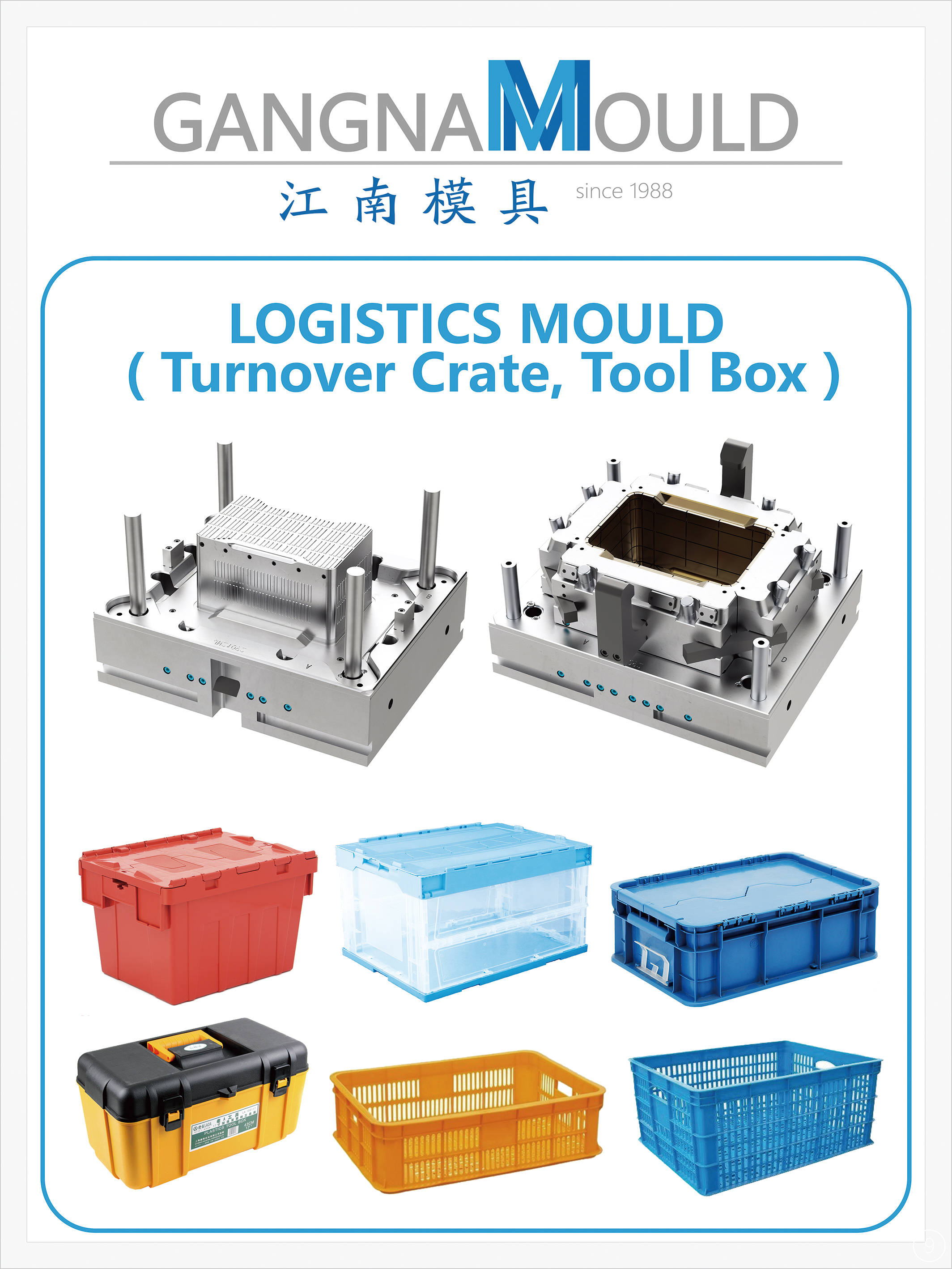
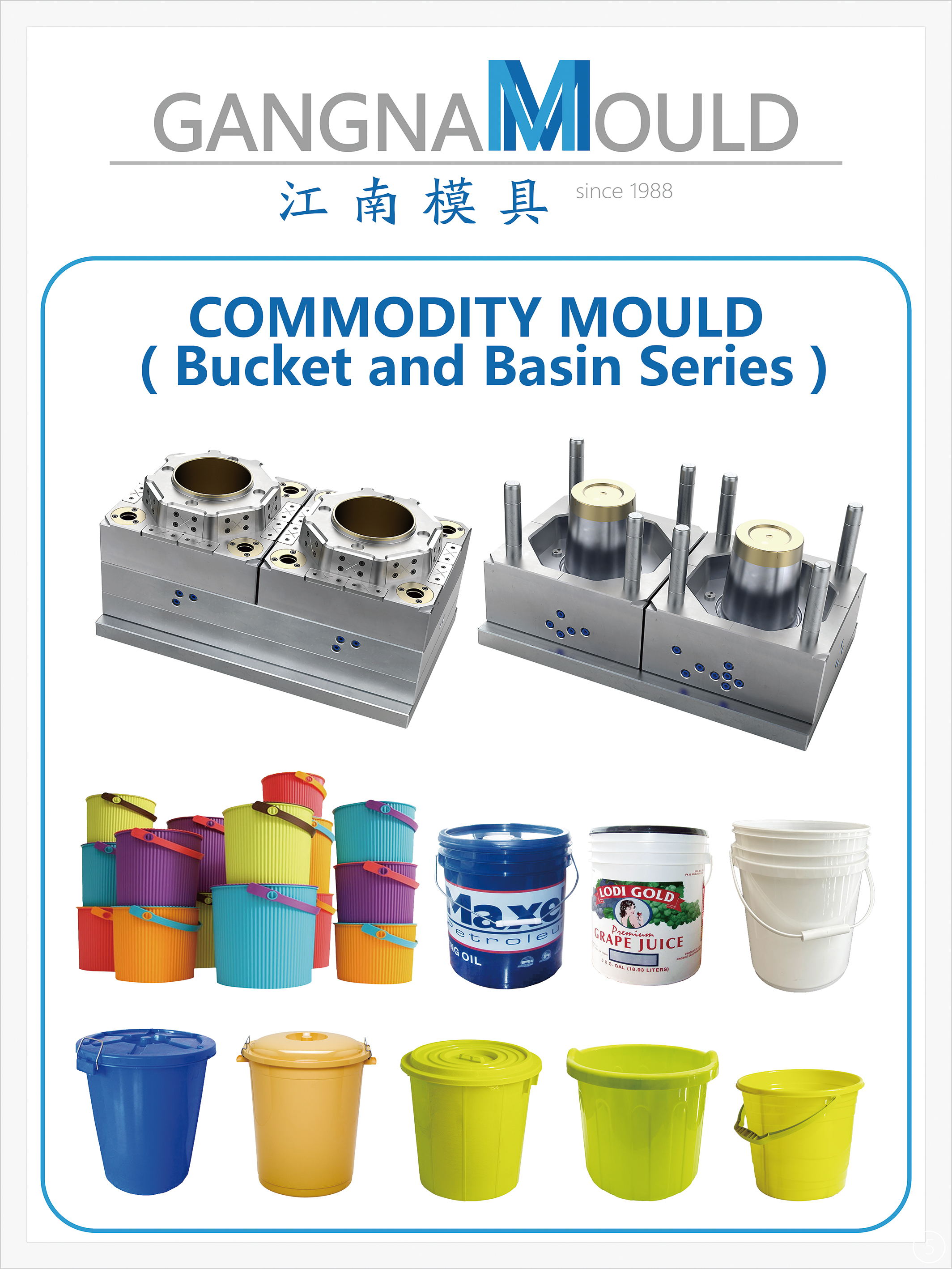
Pallet moulds, crate moulds and turnover box moulds are large, high-cycle tools where cooling design and structural rigidity drive both cycle time and tool life. Over a ten-year supply relationship, GANGNAM MOULD has delivered 800 units of custom moulds to clients in markets including India, Italy, Turkey and Nigeria, applied to injection pallets, circulation crates, daily plastic containers and home appliance housings; the supplier states that these tools are engineered to withstand millions of operational cycles. In an audit, this is the point where references to packaging, retail, logistics and warehousing applications should be tested against trial reports rather than accepted as a category claim.
Household, daily-use and storage products
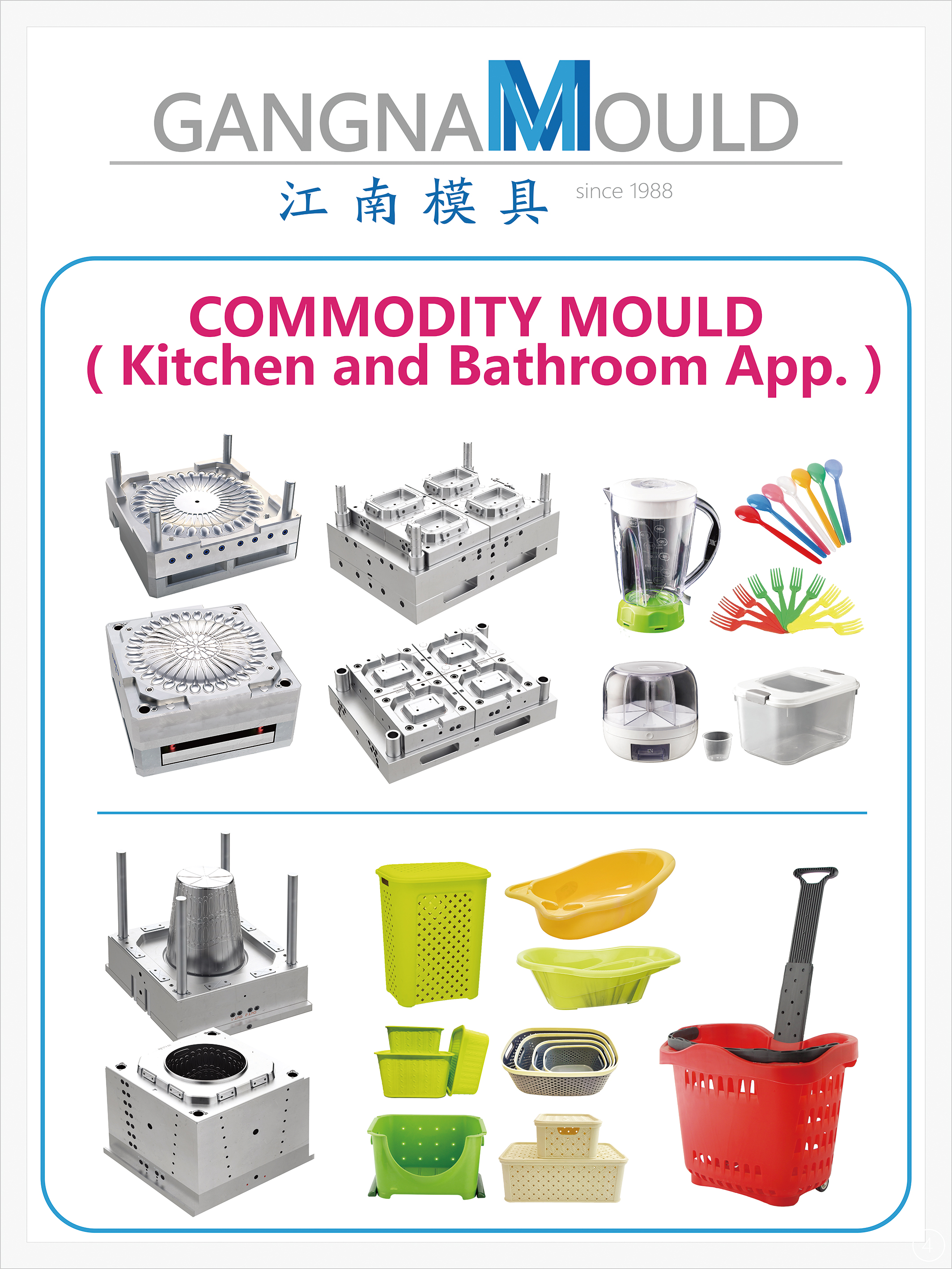
Basin moulds, bucket moulds, trash bin moulds, storage box moulds, basket moulds and tray moulds are usually judged by the end customer in a shop, so surface treatment carries as much commercial weight as dimensional accuracy. These are also the product families where recycled polymers are most commonly specified, which makes material confirmation — not just resin grade, but the actual processing behaviour of the specified material — a standard audit item.
Furniture and seating
Chair moulds, table moulds, stool moulds and sofa moulds sit in a category with substantial volume: the global plastic furniture market was valued at USD 48.7 billion in 2023, with the residential segment holding a 53.1% revenue share, according to Grand View Research. As noted earlier, category estimates vary widely by scope, so the audit value here is not the headline number but the tooling requirement — large parts, visible surfaces, and repeat orders that reward a stable cavity and cooling design.
Kitchen, bathroom and home appliance components
Kitchen utensils moulds, bathroom accessories moulds and home appliance moulds typically involve tighter cosmetic requirements. Thin wall injection moulds sit at the other end of the spectrum: industry research values the global thin-wall mould market at USD 41.6 billion in 2024, driven by injection moulding's ability to produce complex, lightweight designs at minimal cycle times. Thin-wall tools are the clearest test of a supplier's gating and cooling capability, and they should be audited with an explicit trial report rather than a general capability statement.
Garden and outdoor products
Garden planter moulds combine large part size with demanding surface requirements. For these projects the audit should focus on cooling uniformity, venting, and the tolerance control that keeps the first cavity and the last cavity producing parts that match.
Supplier Audit Comparison Table
The table below converts each audit area into the evidence a buyer should request, alongside the verified data points GANGNAM MOULD publishes for its commodity mould product line.
| Audit Area | What to Verify | Evidence to Request | Verified Data Point (GANGNAM MOULD) |
|---|---|---|---|
| Company foundation | History, location, ownership | Company profile, factory address, registration documents | Established 1988; 3,000 m² facility in the Huangyan district of Taizhou, Zhejiang, China; approximately 70% of output exported |
| Machining capacity | Machine inventory and real output | Equipment list, workshop access or live video, capacity statement | More than 20 digital controlled milling machines; 3D coordinate mapping inspector; dedicated mould assembly group; over 800 sets of mould per year (about 80 sets per month) |
| Engineering capability | Design and process engineering depth | Engineering headcount, design review documents | Around 40 staff, including 15 engineers |
| Tooling accuracy | Tolerance, warpage control, batch consistency | Dimensional report, CMM and NDT records, full-size trial report | Stated dimensional tolerance of -0.02 mm; customisable cavity count and size; uniform cooling; optimised gating and venting; surface treatment and tolerance control |
| Quality management | Certification, scope and validity | Certificate with number, issuing body, scope and dates | ISO 9001:2015, certificate 18118Q10459R3S, issued by Beijing Xingguo Inspection and Certification Co., Ltd., scope: Manufacture and Design of Plastic Parts Mould, valid 14 June 2024 – 15 June 2027 |
| Materials | Mould steel and processed plastics | Steel documentation, material suitability confirmation | Quality mould steel; PP, engineering-grade plastics and recycled polymers for packaging, logistics, daily-use and home appliance moulds |
| Commercial terms | MOQ, payment, incoterm | Written quotation and contract clauses | MOQ 1 unit; 30% T/T advance and 70% before shipment; standard FOB/CIF incoterms |
| Delivery and after-sales | Lead time, training, documentation | Process schedule, trial report, training scope | End-to-end manufacturing from samples or drawings to trial moulding and delivery, with installation and operation training; lead time 30–45 days depending on complexity |
Frequently Asked Questions
Are there CE-certified commodity mould manufacturers?
CE marking is a conformity route for products placed on the European market, and it applies to the finished goods rather than to mould tooling itself, so buyers rarely find a CE certificate issued for a mould. What can be verified for a commodity mould supplier is its quality management system and its inspection documentation. GANGNAM MOULD's commodity mould product is certified to the ISO 9001:2015 quality management system under certificate number 18118Q10459R3S, issued by Beijing Xingguo Inspection and Certification Co., Ltd., with the scope “Manufacture and Design of Plastic Parts Mould” and validity from 14 June 2024 to 15 June 2027, applicable to the global market. Buyers who need CE-related documentation for the plastic products produced from the mould should specify that requirement during requirement communication, so the tooling, material and part documentation are aligned from the start.
How do I verify that a commodity mould supplier's capacity is genuine?
Ask for four pieces of evidence: a current machine list, a workshop walkthrough or live video, engineering headcount by function, and a capacity statement expressed in sets per month for your specific mould type. GANGNAM MOULD publishes a capacity base of more than 20 digital controlled milling machines, a 3D coordinate mapping inspector and a dedicated mould assembly group in a 3,000 m² facility, with an annual output of over 800 sets of mould (about 80 sets per month) produced by around 40 staff including 15 engineers. Capacity should then be re-checked against your own tool, because multi-cavity, thin-wall, pallet and crate moulds consume more machine hours than simple single-cavity tools.
What MOQ and payment terms apply to a commodity mould order?
The standard structure for a commodity mould order is a minimum order quantity of 1 unit, a 30% T/T advance with the remaining 70% payable before shipment, and FOB/CIF incoterms. Because these are commercial terms rather than technical specifications, they are negotiated per project and should be confirmed for each order and written into the contract alongside the acceptance criteria.
Can I verify tooling quality through a trial before shipment?
Yes. Trial moulding is the standard verification point in a commodity mould project. GANGNAM MOULD's process runs from samples or drawings through design and manufacturing to trial moulding and inspection before delivery, and the quality-control methods used are NDT, CMM measurement and full-size trial testing with inspection reports. A buyer should treat the trial report as the acceptance document: it should record measured dimensions against the agreed tolerance (a stated -0.02 mm in this case), the trial sample, cooling and gating behaviour, and any corrective actions. Requesting a physical trial sample before shipment is the most direct way to confirm the tool produces parts that match the specification.
What lead time and after-sales support should I expect?
Lead time depends on mould complexity and is confirmed per order; GANGNAM MOULD states a range of 30–45 days, following a process of requirement communication, design, manufacturing, trial and inspection, then delivery with installation and operation training. After-sales support covers mould delivery, installation and operation training, and detailed inspection reports during trial, with specific terms agreed contractually. For a project-specific lead-time estimate, a quotation or a sample evaluation, buyers can send product drawings or samples to GANGNAM MOULD at gm@gangnammould.com or through WhatsApp at +86 150-0576-9999.
Conclusion: Build an Audit File, Not an Impression
A commodity mould supplier audit is a short, repeatable exercise: verify capacity with a machine list, headcount and output statement; verify tooling accuracy with a stated tolerance, a cooling and gating design, and CMM, NDT and full-size trial reports; verify delivery and commercial terms with a written order covering incoterm, payment milestones, lead time and training scope. Suppliers that can answer all three with documents are fundamentally easier to work with than suppliers that answer with adjectives.
The same evidence file pays for itself twice. On the first order, it reduces the risk of a tool that cannot be validated. On repeat orders and second-source evaluations, it gives the buyer a baseline to compare against instead of starting the assessment from zero.
Next Step: Request a Commodity Mould Evaluation
GANGNAM MOULD CO., LTD builds commodity moulds for packaging, retail, consumer goods, logistics and warehousing, and home appliance applications, with end-to-end manufacturing from samples or drawings to trial moulding and delivery. Send your product drawings or a physical sample for a cavity, material and tolerance feasibility review.
Email: gm@gangnammould.com | WhatsApp / Tel: +86 150-0576-9999 | Website: www.gangnammould.com
Company brochure (PDF): Download the GANGNAM MOULD catalogue
Have Questions or Need More Details?
Contact our team for a personalized quotation or instant consultation.
Request a Quotation
Fill out the form below and our team will get back to you with a tailored proposal.
WhatsApp Direct Chat
Prefer to chat in real-time? Message us on WhatsApp for instant assistance & quick answers.
- Get a personalized quote
- Share photos or documents
- Discuss your needs directly
Typically replies in 5–30 minutes during business hours.