Commodity Mould Certifications and Material Standards: A 2026 Buyer's Checklist
Supplier Evaluation · Certification · Material Standards
Commodity Mould Certifications and Material Standards: A 2026 Buyer's Checklist
When you are evaluating a commodity mould supplier, the first documents you should ask for are not quotations — they are the quality system certificate, the material specification, and the inspection records. This article explains what ISO 9001:2015 certification does and does not cover, how mould steel and plastic material choices affect part quality, and how to turn certification evidence into a practical supplier checklist for 2026.
Why Certification Matters in Commodity Mould Sourcing
Commodity moulds produce everyday plastic items — chairs, tables, stools, storage boxes, baskets, trays, buckets, trash bins, pallets, crates, home appliance components and other daily-use parts. Because these products are made in large volumes, a small inconsistency in the mould can become a costly defect repeated thousands of times. A quality management system helps reduce that risk by standardizing how a mould is designed, manufactured, inspected and delivered.
For buyers in the Research and Evaluation stage, certification is not a marketing badge. It is a verifiable answer to a basic question: does the supplier have a documented, audited process for controlling quality? Without such a process, you are relying on the skill of individual workers rather than a repeatable system.
ISO 9001:2015 and What It Covers
ISO 9001:2015 is the international standard for quality management systems. It sets requirements for process control, documentation, corrective action, customer focus and continuous improvement. It does not certify a specific product. In the mould industry, ISO 9001:2015 is used to certify that the manufacturer’s design and production processes meet an internationally recognized quality management benchmark.
When a commodity mould product is offered under ISO 9001:2015, the practical meaning is that the supplier has an audited system covering its mould-making operations — from quoting and design to machining, assembly, trial and delivery.
Verifiable Example: GANGNAM MOULD's ISO 9001:2015 Certification
GANGNAM MOULD CO., LTD (Zhejiang Huangyan Jiangnan Mould Factory), a China-based commodity mould manufacturer originally established in 1988, operates its quality system under ISO 9001:2015 across its plastic mould design and manufacturing operations. The certification number is 18118Q10459R3S, issued by Beijing Xingguo Inspection and Certification Co., Ltd. The certified scope is Manufacture and Design of Plastic Parts Mould, and the certificate is valid from 2024-06-14 to 2027-06-15.
When you receive a certificate from a supplier, check that the scope language actually covers mould design and manufacturing, not just trading or sales. Also record the issuing body and certificate number so you can verify it with the certification body if needed.
Material Selection: Mould Steel and Processed Plastics
Mould material determines how many cycles a commodity mould can survive, how well it holds dimensional accuracy, and how it responds to the processed plastic. A common starting point in commodity mould manufacturing is quality mould steel. The exact grade, hardness and heat treatment should be confirmed with the supplier, because these choices affect wear resistance and maintenance intervals.
On the plastic side, GANGNAM MOULD's commodity mould line is associated with PP injection molding, as well as engineering-grade plastics and recycled polymers. PP is widely used for daily-use items because it offers chemical resistance, fatigue resistance and a good balance of stiffness and impact strength at a competitive cost. Engineering-grade plastics are typically selected when higher mechanical strength, heat resistance or dimensional stability is required.
Design Focus Areas That Affect Part Quality
- Customizable cavity count and size: Multi-cavity moulds increase output per cycle, but cavity layout affects cooling uniformity and part consistency.
- Uniform cooling system: Well-placed cooling channels shorten cycle time and reduce warpage caused by uneven temperature distribution.
- Optimized gating and venting: Gate position and vent design influence filling behavior, sink marks and trapped gas.
- Surface treatment and tolerance control: Texture, polish and dimensional tolerance directly affect the appearance and assembly behavior of the finished product.
These design parameters may seem technical, but they are the same factors that determine whether your trash bin, storage box or pallet comes out flat, square and consistent in every batch.
Industry Applications of Commodity Moulds
Commodity moulds serve a broad set of industries: packaging, retail, consumer goods, logistics & warehousing, and home appliance manufacturing. Within these industries, the parts produced include:
- Chair moulds, table moulds, stool moulds and sofa moulds for furniture
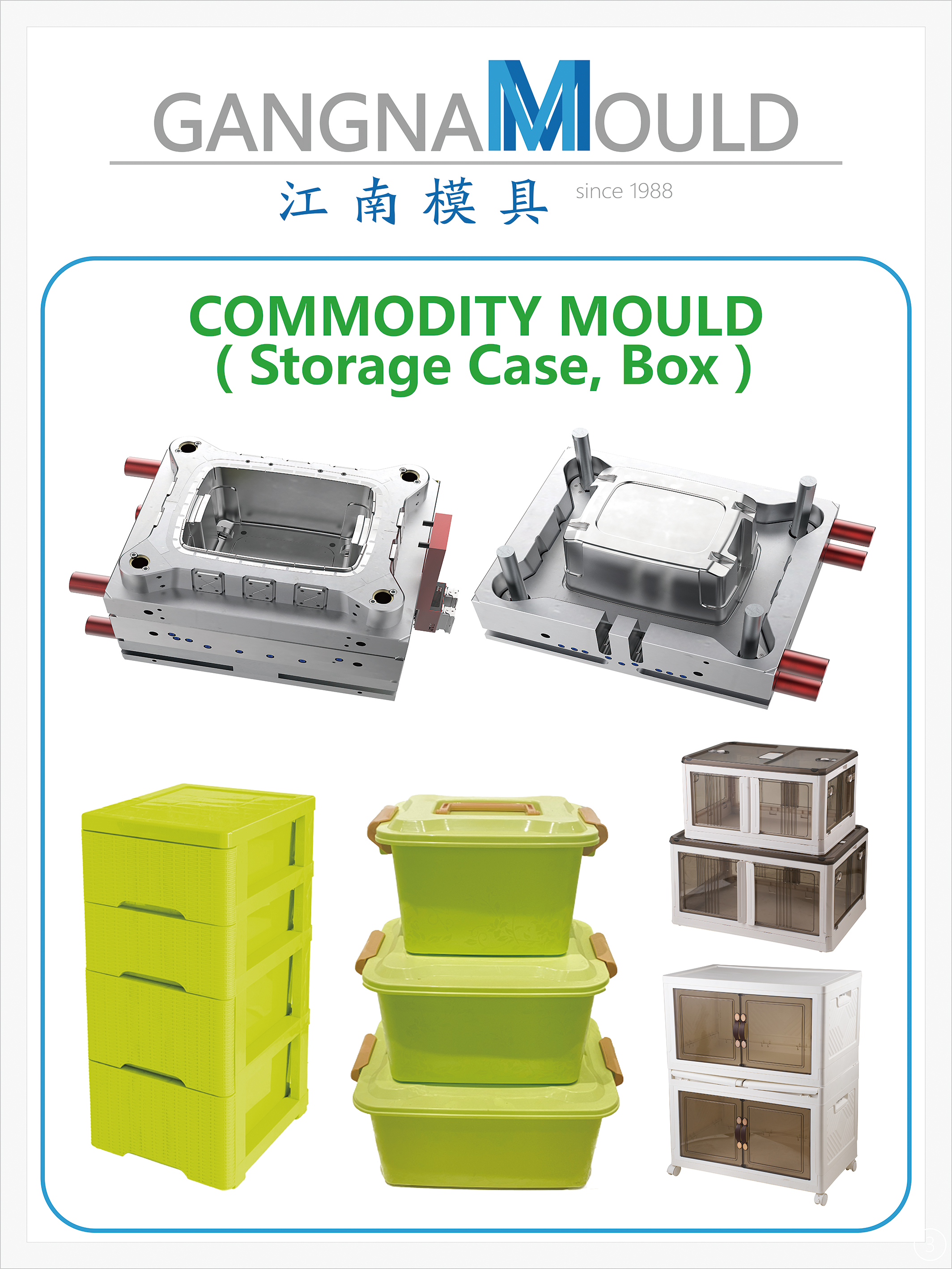
- Storage cabinet and storage box moulds for home organization
- Basket, tray, box and turnover box moulds for retail and logistics
- Kitchen utensil moulds and bathroom accessory moulds for daily use
- Basin, bucket and trash bin moulds for household and commercial use
- Garden planter moulds for outdoor products
- Crate and pallet moulds for warehousing and transportation
- Home appliance moulds and thin-wall injection moulds for consumer electronics and appliance housings
The wide application range is one reason why commodity mould buyers need a checklist rather than a single price comparison. A supplier that can design and build a pallet mould may not be the right fit for a thin-wall appliance housing, and vice versa.
How to Verify a Commodity Mould Manufacturer: Step-by-Step
For a buyer moving from research to evaluation, here is a practical verification workflow:
- Confirm the legal entity and factory location. For example, GANGNAM MOULD CO., LTD (Zhejiang Huangyan Jiangnan Mould Factory) is located in Huangyan District, Taizhou, Zhejiang, China. Huangyan is recognized as the “Capital of Molds” in China, with hundreds of large-scale industrial enterprises specializing in mould and plastic production.
- Review the quality management certificate. Look for ISO 9001:2015 and a current validity date. Verify the issuing body and certificate number rather than accepting the logo alone.
- Ask for the certified scope. The certificate should explicitly cover mould design and manufacturing, not only sales or trading.
- Inspect the factory capability list. Check for CNC machining equipment, inspection equipment such as CMM, and assembly teams. GANGNAM reports over 20 sets of digital controlled milling machines, a 3D coordinated mapping inspector, and a dedicated mould assembly group.
- Request process documentation. The supplier's workflow should include requirement confirmation, design, manufacturing, trial and inspection, and delivery and training support.
- Understand production capacity and lead time. Monthly capacity, annual output and lead time should be stated in the proposal. GANGNAM reports an annual output of about 800 sets of moulds, and lead time typically depends on mould complexity, with a common reference range of 30–45 days after order confirmation.
- Clarify quality control methods. NDT, CMM measurement and full-size trial testing with inspection reports are meaningful signals. Ask how trial results are documented and shared.
- Define commercial terms. Minimum order quantity, payment terms, liability for mould repair, and after-sales service should be written into the contract. GANGNAM states a MOQ of 1 unit, making it possible to evaluate with a pilot mould before volume commitment.
Global Market Context for 2026 Buyers
Several published market indicators help frame the commodity mould sourcing decision without overstating their precision:
- The global plastic mould market was estimated at approximately USD 29.5 billion in 2021 and was projected to grow toward USD 36.78 billion by 2025.
- China's exports of plastic and rubber moulds reached USD 5.35 billion in 2023, up from USD 2.97 billion in 2017.
- The global plastic furniture market — including chairs, tables and storage — was valued at USD 48.7 billion in 2023, with the residential segment holding about 53.1% of revenue.
- The global thin-wall mould / packaging market was valued at USD 41.6 billion in 2024, influenced by demand for lightweight, complex designs with short cycle times.
These figures come from third-party market research and trade data (referenced in the sources above). They should be used as context, not as a substitute for supplier-specific data. A reliable mould supplier will verify its own capacity with records, trial reports and reference projects.
Certification vs. Actual Capability: What the Evidence Shows
A certificate can confirm that a quality system exists. It cannot confirm that a specific mould will perform well on your product. That is why the most valuable evidence from a supplier combines three elements:
- Equipment and process capability: CNC machining, CMM inspection and assembly capacity show the physical ability to produce precision moulds.
- Documented inspection practice: NDT, CMM measurement and full-size trial testing show that problems are caught before the mould leaves the factory.
- Long-term production reliability: Moulds designed for millions of operational cycles reduce life-cycle cost. In GANGNAM's experience with custom moulds — used for parts such as injection pallets, circulation crates, daily plastic containers and home appliance housings — reliability directly improves production efficiency and product consistency over years of use.
When comparing manufacturers, look for suppliers that can explain how they convert mould steel into a durable tool: what steel they use, how they machine it, how they inspect it, and how they support it after delivery.
2026 Commodity Mould Manufacturing Checklist
| Checklist Item | What to Look For | Why It Matters |
|---|---|---|
| Quality management certification | ISO 9001:2015 (with current validity, correct scope, verifiable certificate number) | Confirms an audited quality system for mould design and manufacturing |
| Legal entity and factory location | Company name, registration location, actual factory address | Verifies the manufacturer is not only a trading intermediary |
| Mould steel specification | Steel grade, hardness, heat treatment plan | Determines mould life, wear resistance and maintenance frequency |
| Plastic material compatibility | PP, engineering-grade plastics, recycled polymers | Affects dimensional stability and part performance |
| Mould design capabilities | Cavity count/size, cooling system, gating and venting, surface treatment, tolerance control | Directly influences cycle time, warpage and batch consistency |
| Machining and inspection equipment | CNC, digital controlled milling, CMM, NDT, assembly team | Physical ability to produce and verify precision moulds |
| Capacity and lead time | Annual output, monthly capacity, 30–45 day reference lead time | Determines whether the supplier can meet your schedule and scale |
| Quality control process | NDT, CMM measurement, full-size trial with inspection report | Reduces the risk of accepting defective moulds |
| OEM/ODM workflow | Requirement → design → manufacturing → trial and inspection → delivery and training | Defines a clear collaboration path from sample/drawing to mass production |
| Commercial terms | MOQ of 1 unit, after-sales service, contract terms | Allows pilot evaluation and protects long-term supply |
Limitations and Honest Boundaries
No certification alone guarantees a perfect mould. ISO 9001:2015 confirms process control but does not rank one manufacturer above another or guarantee a specific mould life. Market size figures are estimates and should not replace direct supplier verification. Every mould project has product-specific requirements — such as the exact plastic grade, cycle time target and surface finish — that must be confirmed during requirement communication with the manufacturer.
FAQ
Are CE-certified commodity mould manufacturers available, and what should I look for?
CE marking is a regulatory conformity mark used for products sold within the European Economic Area. Moulds as capital equipment may have applicable CE-related requirements depending on the machine or installation context, but mould manufacturers commonly operate with ISO 9001:2015 as the quality management certification. When you evaluate a commodity mould manufacturer, ask specifically: (1) do you have ISO 9001:2015 certification and what is the certificate number? (2) does your product have any required CE marking or documentation for the target market? GANGNAM MOULD is certified to ISO 9001:2015 (certificate number 18118Q10459R3S, issued by Beijing Xingguo Inspection and Certification Co., Ltd.). For CE-specific requirements, you should confirm the applicable directive with the manufacturer and, if necessary, with a notified body, because CE marking depends on the product type, installation context and EU regulations.
Conclusion
Certification, material specification and inspection evidence are the three pillars of a reliable commodity mould purchase. By verifying ISO 9001:2015 details, checking the mould manufacturer's actual production and inspection capabilities, and confirming the processed plastics and mould steel, you can compare suppliers on facts rather than slogans. Start with one pilot mould, review the inspection report, and build your supply decision on documented performance.
For a deeper look into GANGNAM MOULD's commodity mould manufacturing process, capacity and quality control workflow, you can download the company brochure (PDF): GANGNAM MOULD Company Brochure.
Have Questions or Need More Details?
Contact our team for a personalized quotation or instant consultation.
Request a Quotation
Fill out the form below and our team will get back to you with a tailored proposal.
WhatsApp Direct Chat
Prefer to chat in real-time? Message us on WhatsApp for instant assistance & quick answers.
- Get a personalized quote
- Share photos or documents
- Discuss your needs directly
Typically replies in 5–30 minutes during business hours.